囮
Character Story & Explanation
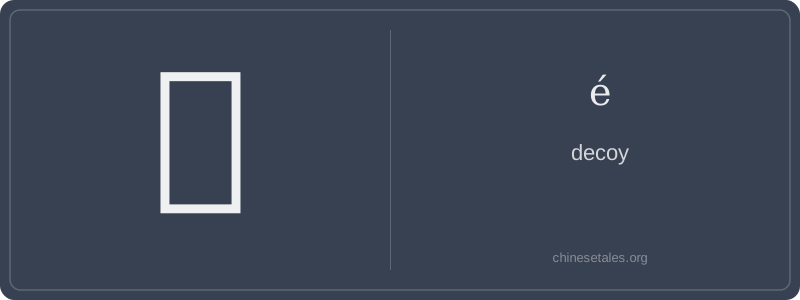
The earliest form of 囮 appears in bronze inscriptions from the late Zhou dynasty — not as a pictograph of a bird per se, but as a stylized cage (冂) containing a simplified bird glyph (几 + 丿, resembling wings and a beak). Over centuries, the cage radical hardened into 冂, while the bird evolved: the original bird head became 匸 (a variant of ‘enclosure’), and the tail/feathers condensed into 一 and 丶 — resulting in today’s elegant, compact shape: 冂 + 匸 + 一 + 丶. Every stroke whispers containment and stillness — no flapping, no flight, just waiting.
This visual logic directly shaped its semantic journey. In the Erya (3rd c. BCE), 囮 was defined plainly as 'a bird used to attract others'. By the Tang dynasty, it appeared in poetry with layered irony — Li He wrote of a caged 囮 singing so beautifully it made wild birds weep before flying into nets. The character never lost its visceral, almost moral charge: the decoy isn’t passive bait; it’s a sentient lure, complicit by song. Its form — tight, enclosed, minimal — mirrors the paradox at its heart: freedom sacrificed to simulate freedom.
At first glance, 囮 (é) feels like a linguistic ghost — it’s rare, poetic, and carries the hushed tension of a trap laid in silence. Its core meaning is 'decoy', specifically a live bird used to lure other birds into nets or traps. Unlike general words for 'bait' (bèi) or 'lure' (yòu), 囮 implies agency, vulnerability, and sacrifice: the decoy isn’t inert — it’s a living creature singing to betray its own kind. That emotional weight lingers even in modern metaphorical use.
Grammatically, 囮 functions almost exclusively as a noun, often embedded in classical or literary compounds (e.g., 囮子, 囮鸟). You won’t find it in everyday speech or HSK vocabulary — it’s the kind of word that appears in Ming dynasty hunting manuals or contemporary essays on ecological ethics. Learners rarely encounter it in isolation; instead, it surfaces in fixed terms where its nuance is essential. Crucially, it’s *not* used as a verb ('to decoy') — that role belongs to verbs like yòu or qǐng. Misusing 囮 as a verb (e.g., '他囮了猎物') is a classic fossilized error among advanced learners.
Culturally, 囮 embodies an ancient, uneasy balance between human ingenuity and natural empathy. Classical texts like the Qimin Yaoshu (6th c. CE) describe 囮鸟 with clinical precision — yet poets like Tao Yuanming subtly condemned the practice, framing the decoy as a tragic figure. Modern conservationists sometimes invoke 囮 to critique unsustainable trapping, giving the character unexpected ethical resonance. Its rarity means learners who master it signal deep cultural literacy — not just vocabulary recall.