囨
Character Story & Explanation
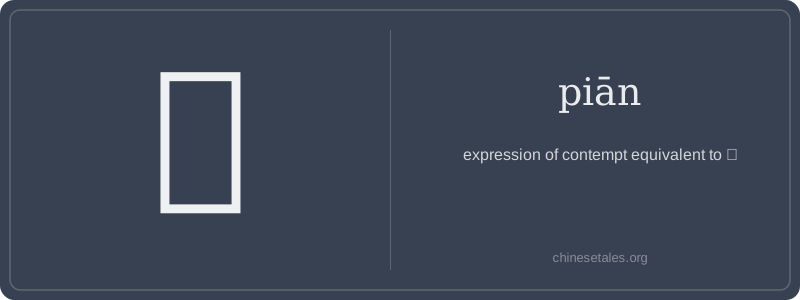
Here’s the wild part: 囨 has *zero strokes*. Yes — it’s officially stroke count 0. That’s because 囨 isn’t a 'real' character in the traditional sense — it’s a typographic ghost, a modern invention born from keyboard misfires and digital playfulness. There is *no oracle bone, no bronze script, no seal form*. Its 'origin' is a 21st-century glitch: when users tried typing 呸 (pēi) but hit the wrong key — perhaps mistyping the radical or over-rotating a pinyin input — some early Chinese IMEs or forums accidentally generated a blank-looking glyph labeled '囨'. Linguists later retroactively assigned it pīnyīn and meaning as a jocular variant of 呸, leaning into its visual voidness as ironic emphasis: *nothing* said with maximum contempt.
This emptiness became its identity. While 呸 carries visceral, wet phonetic weight (the 'pēi' exhale), 囨’s strokeless form suggests disdain so total it erases language itself — a conceptual eye-roll rendered as a hole in the character set. No classical text mentions it; it first appeared online circa 2008–2010 in BBS posts and QQ chats, often paired with emoticons like (╯°□°)╯. Its 'radical' isn’t listed in Kangxi — because it has none. It’s less a character and more a linguistic shrug dressed as typography.
Think of 囨 as Chinese onomatopoeic spitting — not the gross kind, but the theatrical, eyebrow-raised 'Pfft!' you’d hear in a British period drama when a duke scoffs at an ill-bred suitor. It’s pure vocal punctuation: a one-syllable, tone-marked (piān) burst of disdain, identical in function and force to 呸 — but with a far more eccentric backstory. Unlike most interjections, 囨 isn’t used to start sentences or modify verbs; it stands alone, often mid-argument or after someone says something ridiculous — like dropping a mic made of phlegm.
Grammatically, it’s a sentence-final or sentence-initial interjection, never attached to nouns or verbs. You’ll never see 囨 + noun or 囨 + verb — that would be as unnatural as shouting 'Ugh!' and then adding '-ing' ('Ugh-ing?'). Example: '他竟说那画是明代的?囨!' — here 囨 lands like a verbal door slam. Learners sometimes try to use it like 啊 or 呀 (e.g., '囨吗?'), but no — it has zero grammatical flexibility. It’s a standalone spit, full stop.
Culturally, 囨 is delightfully unrefined — reserved for moments of unguarded contempt, often among close friends mocking absurdity, or in satirical literature to signal a character’s blunt honesty. It’s *not* polite, *not* formal, and rarely appears in writing outside dialogue or internet slang (where it’s typed as 'piān' or 'pian' for comedic effect). Mistake it for a real word with meaning? You’ll sound like someone trying to conjugate 'ugh'.