囧
Character Story & Explanation
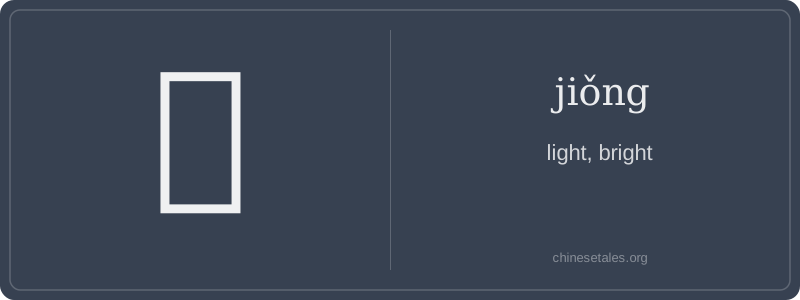
The earliest form of 囧 appears in oracle bone inscriptions (c. 1200 BCE) as a striking pictograph: a large square or rounded frame with a small dot or short line in the center—like a sunlit window in a mud-brick wall or a stylized eye catching light. Over centuries, the outer frame sharpened into clean corners (口 shape), and the inner element evolved from a dot (•) to a horizontal stroke (一), then to the modern '八' shape—two diverging lines suggesting radiating light. Bronze script versions emphasize symmetry and balance, while seal script standardizes the 'mouth' radical enclosing the 'light rays'—a perfect visual metaphor for light emerging from containment.
This character wasn’t just decorative: in the *Book of Documents* (*Shūjīng*), the phrase '冏命' (jiǒng mìng) names a royal decree about illuminating virtue—'the bright command'. Confucian scholars later used 囧 to evoke moral lucidity: when the mind is unclouded, it is 囧然. Its visual stillness—a centered, open frame—mirrors the Daoist ideal of wúwéi (effortless presence): brightness without glare, clarity without judgment. Even today, calligraphers prize its balanced geometry: eight strokes forming a calm, radiant void.
Think of 囧 like the ancient Chinese version of a lightbulb emoji —not because it’s modern (it’s over 3,000 years old!), but because its original meaning was literal 'light' or 'brightness', and its shape looks uncannily like a glowing window or a radiant face. In classical texts, 囧 appears in phrases like '囧然' (jiǒng rán), meaning 'brightly clear' or 'illuminated', often describing moonlight or moral clarity—like a Zen master pointing to the full moon and saying, 'That is 囧.' It’s not used alone in modern speech; you’ll only encounter it embedded in literary compounds or as internet slang.
Grammatically, 囧 functions almost exclusively as a morpheme inside compound words—not as a standalone verb, noun, or adjective in daily conversation. Learners sometimes try to use it like 'bright' in English ('The room is 囧!'), but that’s a classic faux pas: native speakers would say 明亮 (míngliàng) or 亮 (liàng). 囧 doesn’t take aspect particles (了, 过), doesn’t reduplicate, and never appears in beginner textbooks because it’s functionally obsolete—except online, where it took a wild detour…
Here’s the cultural twist: since the early 2000s, 囧 went viral as an emoticon—the square 'window' became a cartoon face with wide, startled eyes and a downturned mouth (□ → ). Suddenly, 囧 meant 'awkward', 'dazed', or 'facepalm'. This semantic U-turn—from luminous clarity to cringe-worthy embarrassment—is uniquely Chinese internet alchemy. Don’t translate it literally; context rules everything. If you see 囧 in a WeChat chat, it’s not philosophy—it’s someone just spilled coffee on their laptop.