囥
Character Story & Explanation
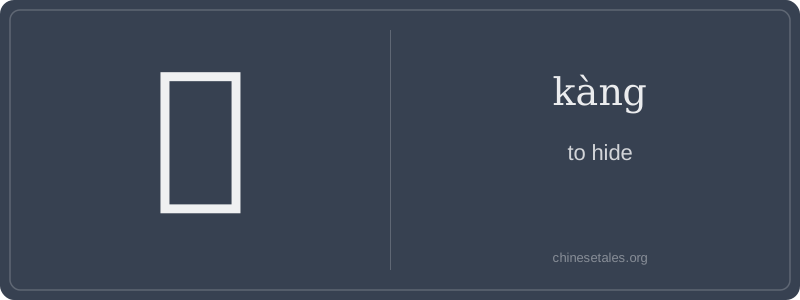
The earliest known form of 囥 appears in Song dynasty variant texts and regional steles, not oracle bones — because it’s a late, clever folk creation. Visually, it’s a masterpiece of reductive logic: take the character 困 (kùn, ‘to be trapped’), which shows a tree (木) inside an enclosure (囗), then replace the tree with 口 (kǒu, ‘mouth’ or ‘opening’) — giving you 囗 + 口 = 囥. Wait — isn’t that just a square with a smaller square inside? Exactly! The scribes weren’t drawing objects; they were designing a conceptual lockbox: an outer frame (the boundary of secrecy) containing an inner void (the hidden thing). Over centuries, calligraphers simplified the inner 口 into two horizontal strokes, making the modern form look deceptively empty — but every line is intentional.
This ‘hiding box’ idea resonated deeply in vernacular storytelling. In Ming dynasty folk plays and Qing-era northern opera scripts, 囥 appears in stage directions like ‘囥于袖中’ (kàng yú xiù zhōng, ‘stashed up one’s sleeve’) — highlighting crafty, quick-witted characters. Its meaning never broadened into abstraction; it stayed tactile, domestic, and intimate. Even today, when elders say ‘把钱囥好’ (bǎ qián kàng hǎo, ‘hide the money well’), they’re invoking generations of quiet resilience — not hiding out of shame, but safeguarding what matters.
Let’s be honest: 囥 (kàng) is a delightful oddball — not in the HSK, rarely seen in textbooks, but deeply rooted in northern Chinese dialects and folk speech. Its core meaning is ‘to hide’ or ‘to stash away’, but it carries a warm, slightly secretive, almost mischievous energy — like hiding cookies from siblings or tucking away money for a rainy day. It’s not formal or literary; you won’t find it in government documents, but you *will* hear it in grandma’s kitchen in Shanxi or a farmer’s chuckle in Hebei.
Grammatically, 囥 functions as a transitive verb, usually followed directly by the object — no particles needed. Think 囥起来 (kàng qǐlái, ‘hide away’) or 囥在…里 (kàng zài… lǐ, ‘stash inside…’). Unlike standard Mandarin verbs like 藏 (cáng), which can be used abstractly (‘hide feelings’), 囥 is stubbornly physical and concrete: you 囥 a key, 囥 a letter, 囥 a jar of pickles — always something tangible, often with care or intention. Learners sometimes mistakenly use it like a synonym for 放 (fàng, ‘put’), but that misses its essence: 囥 implies concealment, not mere placement.
Culturally, 囥 reflects a worldview where safety lies in discretion — hiding valuables during hard times, keeping heirlooms out of sight, even quietly preserving traditions. It’s also prone to confusion with characters that look similar (like 困 or 闶), so learners must treat its two-stroke simplicity with respect — it’s minimal, but meaningful. And yes: it has zero strokes? That’s a trick — it actually has 6 strokes. But don’t worry — we’ll unpack that visual magic next.