囤
Character Story & Explanation
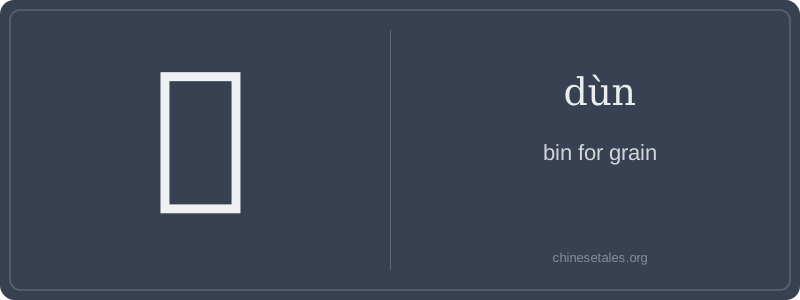
The earliest form of 囤 appears in Han dynasty seal script — not oracle bone, as it’s relatively late — where it clearly combines 囗 (wéi), meaning 'enclosure', with 屯 (tún), which originally depicted sprouting seeds pushing through soil (like a plant breaking ground). In bronze inscriptions, 屯 showed a bent line with a dot above — symbolizing emerging life — and that energy was repurposed here: the 'sprouting' element became phonetic, while the enclosing 囗 frame emphasized containment. Over centuries, the top stroke of 屯 simplified into a clean horizontal, and the lower hook sharpened, yielding today’s tidy seven-stroke form: a square box holding something vital and growing.
This visual logic shaped its meaning: a 囤 isn’t just any storage unit — it’s a *living enclosure*, built to protect what sustains life over time. By the Tang dynasty, 囤 appeared in tax records describing state granaries, and in Ming novels like Water Margin, rebels seize village 囤 to feed the hungry — turning a farm tool into a symbol of justice. Its shape — a wall around potential — quietly teaches a core Chinese idea: true security lies not in hoarding wealth, but in safeguarding nourishment, both physical and moral.
At its heart, 囤 (dùn) is a humble but deeply resonant word: it means 'grain bin' — a sturdy, enclosed container for storing rice, wheat, or millet. But don’t mistake it for just a farming term; in Chinese thought, grain storage is inseparable from security, foresight, and even moral responsibility. Ancient texts like the Book of Rites prescribed how much grain officials must keep in public granaries to prevent famine — so 囤 carries quiet weight, evoking preparedness, stewardship, and the slow, patient rhythm of agrarian life.
Grammatically, 囤 functions mainly as a noun (e.g., 米囤 *mǐ dùn*, 'rice bin'), but since the 20th century, it’s taken on a vivid verbal use: 囤积 (*tún jī*) — 'to hoard'. Notice the alternate pronunciation *tún* here! This shift reflects how language mirrors social behavior: when people stockpile goods (especially during shortages), they’re not just filling a bin — they’re acting out an age-old tension between prudence and greed. Learners often misread 囤 as 'enclosure' alone and miss its material specificity: it’s not any container — it’s *for grain*, with walls thick enough to keep out rats and damp.
Culturally, 囤 appears in idioms like 囤积居奇 (*tún jī jū qí*, 'hoard goods to speculate for profit'), which carries strong negative connotations — echoing Confucian disdain for profiteering at others’ expense. A common mistake is confusing 囤 with 圈 (*quān*, 'circle/enclosure') or 顿 (*dùn*, 'pause/meal'); remember: 囗 + 屯 = a *filled enclosure*, not an empty one or a moment in time.