囡
Character Story & Explanation
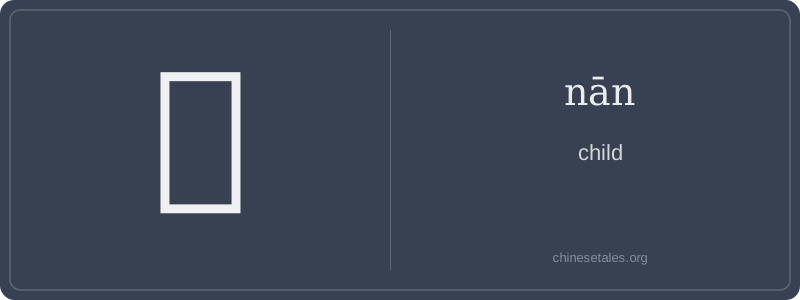
The earliest form of 囡 appears in Song dynasty variant scripts (not oracle bones — it’s relatively late!), evolving from a simplified combination of 女 (nǚ, 'woman') inside 囗 (wéi, 'enclosure'). Originally, scribes in the Jiangnan region wrote 女 enclosed in a square to highlight 'a girl within the family circle' — visually framing femininity and youth. Over centuries, the outer square became more stylized and uniform, while the inner 女 shrank and rotated, eventually losing its distinct legs and arms to become the two horizontal strokes and dot we see today. The six-stroke modern shape is highly streamlined — almost cartoonish in its simplicity.
This character didn’t appear in classical texts like the Analects or Zhuangzi; it emerged organically in Ming-Qing vernacular literature and local opera scripts from the Yangtze Delta. In Wu folk songs, 囡 often rhymes with words like 天 (tiān, 'sky') and 边 (biān, 'side'), reinforcing its lyrical, oral roots. Its visual design — a small figure nestled in a square — mirrors the cultural ideal of a cherished daughter protected within the domestic sphere, making it less a lexical item than a miniature cultural portrait.
囡 (nān) is a tender, affectionate word for 'child' — but not just any child: it’s almost exclusively used in the Wu dialect region (Shanghai, Ningbo, Suzhou), especially for young girls or babies. Think of it as the linguistic equivalent of a soft pinch on the cheek — warm, intimate, and slightly old-fashioned. It carries no formal or bureaucratic weight; you won’t find it in government documents or school textbooks, and it’s absent from the HSK list precisely because it’s regional, not standard Mandarin.
Grammatically, 囡 functions mostly as a noun, often reduplicated as 囡囡 (nān nān) for extra sweetness — like calling someone 'sweetie-sweetie'. It can also appear in compound nouns like 阿囡 (ā nān), where 阿 is a familiar prefix (like 'Auntie' or 'Uncle', but here used affectionately toward a child). Crucially, it’s never used alone in formal speech or writing; if you say 'I have a 囡' in Beijing, people might blink and ask, 'A what? A rice cake?' — because outside Wu-speaking areas, this character is virtually unknown.
Culturally, 囡 reveals how Chinese characters encode regional identity and familial intimacy. Learners often mistakenly assume it’s interchangeable with 孩子 (háizi) or 小孩 (xiǎo hái), but that’s like swapping 'bairn' (Scots) for 'child' in American English — same core meaning, totally different register and geography. A common error is misreading the 囗 radical as 'enclosure' and guessing 'caged child' — but in fact, it’s a stylistic enclosure for emphasis and phonetic harmony, not literal confinement.