囟
Character Story & Explanation
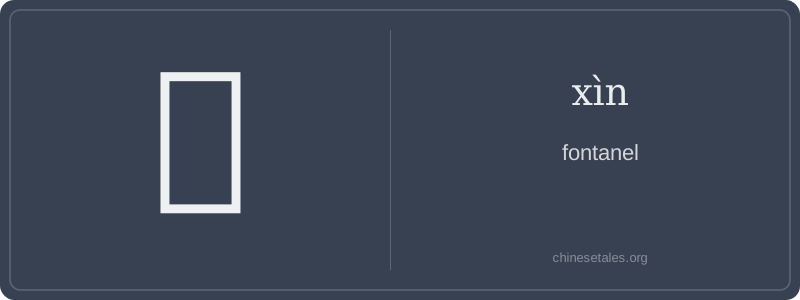
The earliest form of 囟 appears in Shang dynasty oracle bone inscriptions as a square or circular enclosure with four radiating lines—like a stylized cross-section of an infant’s skull with the soft, diamond-shaped gap at the top. Think of it as a bird’s-eye view: the outer 囗 (wéi) frame represents the cranial perimeter, while the inner strokes (originally four short lines, later simplified to two crossing diagonals) depict the open sutures. Over centuries, bronze script tightened the shape; seal script standardized the ‘X’ inside the square; and by clerical script, the crossing strokes had fused into the clean, minimalist 囟 we write today—six strokes total, all essential, no flourish.
This wasn’t just anatomy—it was cosmology. In early texts like the *Shuōwén Jiězì* (121 CE), Xu Shen defines 囟 as ‘the aperture where heaven’s qi enters the body,’ linking the infant’s vulnerable crown to celestial connection. Later, Daoist and medical traditions treated the 囟门 as a subtle energy portal—hence why classical prescriptions sometimes reference ‘nourishing the 囟’ to support brain development. Even today, some TCM practitioners palpate the 囟 to assess a child’s constitutional strength—making this tiny character a living bridge between Bronze Age symbolism and modern pediatrics.
Picture a newborn’s soft, pulsing spot on the crown of the head—the fontanel—where skull bones haven’t yet fused. That’s 囟 (xìn): not just a medical term, but a character that breathes with biological intimacy. In Chinese, it carries no grammatical function—it never appears as a verb, adjective, or particle—but serves exclusively as a precise anatomical noun, almost always in compound words or clinical contexts. You’ll rarely hear it alone in speech; it’s a ‘doctor-only’ word, like 'occiput' in English—technically correct, culturally reserved.
Grammatically, 囟 is strictly bound: it only appears in fixed compounds (e.g., 囟门 xìn mén, ‘anterior fontanel’) and is never reduplicated, modified by aspect particles (了, 过), or used predicatively. Learners sometimes mistakenly treat it like a general ‘head’ character (confusing it with 头 tóu) or misplace it in colloquial baby talk—but native speakers would instantly flag that as unscientific or even eerie. It belongs in pediatric charts, not playground banter.
Culturally, 囟 subtly echoes traditional Chinese medicine’s view of the head as a gateway for vital energy (qì). The *Huangdi Neijing* references the fontanel’s closure timing as a sign of healthy qi and kidney essence development. Modern parents may check the 囟门’s tension during wellness visits—but few know the character’s ancient pictographic roots. That disconnect—between its clinical precision today and its Bronze Age origin as a sacred ‘sky-opening’ symbol—is what makes 囟 quietly fascinating.