囝
Character Story & Explanation
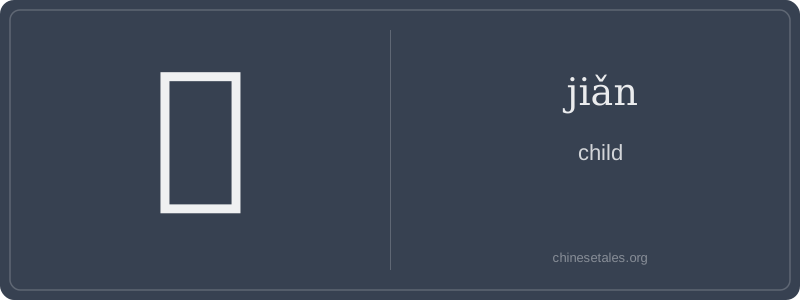
The earliest form of 囝 appears in late Tang steles and Song dynasty rhyme dictionaries — not oracle bones, but surprisingly young for such a simple character. Its structure is deliberately iconic: the outer 囗 (wéi) is a 'boundary' or 'enclosure', representing protection or containment, while the inner 元 (yuán) — simplified here to ㄙ-like strokes — originally depicted a person’s head and arms raised, symbolizing vulnerability and dependence. Over centuries, the inner part stylized from a full human figure into the minimal three strokes we see today, but the enclosure remained dominant — visually encoding the idea of a child as something tenderly held within family or home.
This 'enclosed person' concept resonated deeply in classical usage: the Tang poet Gu Kuang wrote '阿囝别来无恙乎?' ('Has my dear child been well since we parted?') — using 囝 to evoke intimate familial sorrow. In Ming-Qing vernacular fiction, 囝 appears in maternal lullabies and fisherfolk dialogues, always carrying softness and closeness. Even today, in Taiwanese Hokkien, '囝仔' (jiǎn-á) remains a common, affectionate term for 'child' — proving that this six-stroke glyph, born from poetic pragmatism, outlived imperial dynasties by clinging to the heart, not the grammar book.
Think of 囝 as the Chinese equivalent of a cozy, old-fashioned English word like 'bairn' — it’s not the standard term for 'child' (that’s 孩子 or 儿子/女儿), but a warm, regional, almost poetic variant, mostly heard in southern dialects like Minnan and Wu. It carries gentle affection, sometimes nostalgia or rustic charm — like calling your niece 'little lamb' instead of 'kid'. It’s never used formally or in writing outside literature or folk songs, and you’ll almost never hear it in Beijing or Shanghai Mandarin.
Grammatically, 囝 functions like a noun — usually as a standalone term of address ('Hey, 囝!') or in possessive phrases like 阿囝 (ā jiǎn, 'my dear child'), but it doesn’t take measure words (no 一个囝) and can’t be pluralized with 们. Crucially, it’s *not* interchangeable with 子: you wouldn’t say 我囝 to mean 'my son' in standard speech — that would sound like quoting a fisherman from Xiamen. Learners often mistakenly slot it into textbook Mandarin sentences, creating unintentional dialect flavor or mild confusion.
Culturally, 囝 is a linguistic time capsule: preserved in Tang dynasty poetry and Fujian opera lyrics, it’s now mostly a marker of regional identity or literary artifice. Mistaking it for a general-purpose synonym for 'child' is like using 'thou' in a business email — technically correct, historically rich, but wildly out of place. Its rarity in modern media means even many native speakers outside the southeast have to pause and recall its meaning.