囗
Character Story & Explanation
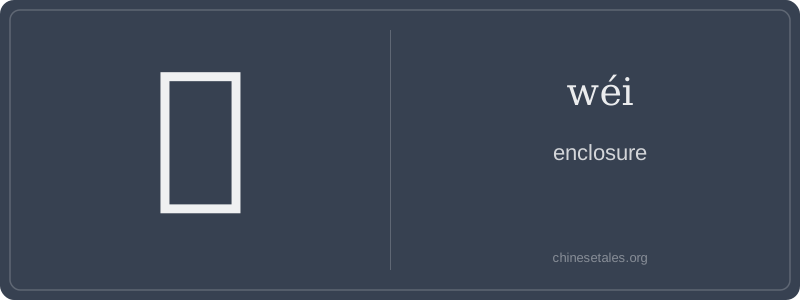
Carved onto oracle bones over 3,000 years ago, 囗 began as a simple, unbroken loop — a circle drawn with one fluid motion, representing a walled settlement or sacred enclosure. In bronze inscriptions, it became slightly more angular, with four distinct corners, then gradually simplified: the upper-left corner softened, the bottom stroke extended rightward for stability, and the top stroke lifted just enough to avoid merging with the right — resulting in today’s elegant, three-stroke square. Crucially, it was *never* meant to be a ‘door’ or ‘gate’: no opening, no entrance — just pure, unbroken containment.
This visual integrity shaped its semantic legacy. In the *Shuōwén Jiězì* (121 CE), China’s first dictionary, Xu Shen defined 囗 as ‘wéi, meaning to surround — like walls enclosing a city.’ Classical texts used it implicitly: when Mencius wrote of ‘a state with well-defined borders’ (有封疆之界), the very idea of ‘boundary’ invoked 囗’s form. Even today, every time you write 圆 (yuán, ‘circle’) or 困 (kùn, ‘trapped’), you’re tracing that same ancient loop — not as decoration, but as a grammatical signature of containment, inherited across millennia.
Think of 囗 not as a ‘word’ you’ll use in daily chat, but as the invisible architect behind hundreds of Chinese characters — a silent, three-stroke frame that says, ‘What’s inside this boundary belongs together.’ Its core meaning is *enclosure*: a wall, a border, a conceptual container. Visually, it’s a perfect square (well, almost — the bottom stroke curves slightly rightward), and that shape alone evokes containment: think of a fence, a city wall, or even the outline of a TV screen framing what’s inside.
Grammatically, 囗 never stands alone in modern usage — it’s exclusively a radical (部首), appearing at the top or left of compound characters like 国 (guó, 'country'), 囚 (qiú, 'prisoner'), or 囚禁 (qiūjìn, 'to imprison'). You won’t type 囗 into WeChat or hear it spoken in isolation — but you *will* see its shadow everywhere. Learners sometimes mistakenly try to use it as a standalone word (e.g., saying ‘wéi’ for ‘area’), but that’s like pronouncing the letter ‘C’ and expecting ‘circle’ — it’s the *form*, not the function.
Culturally, this character embodies an ancient Chinese worldview: order arises from clear boundaries — between self and society, inside and outside, safe and dangerous. Confucian texts stress ‘defining the circle’ (正名, zhèngmíng) before acting — a philosophical echo of 囗’s shape. A common mistake? Confusing it with 口 (kǒu, ‘mouth’) — same stroke count, but 口 is smaller, squarer, and *alive* with sound; 囗 is larger, more deliberate, and fundamentally *silent*. It doesn’t speak — it defines the space where speech happens.