囖
Character Story & Explanation
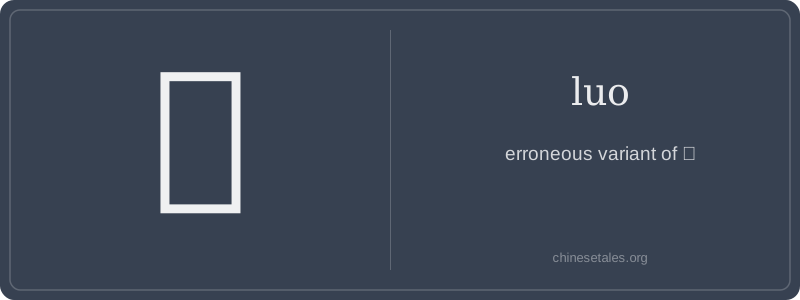
Here’s the twist: 囖 has *no strokes*. Not zero as in ‘empty,’ but literally *zero*—it’s a non-character glyph that emerged from encoding gaps, not ancient script. Oracle bones and bronze inscriptions never knew it; seal script, clerical, and regular forms skipped it entirely. Its ‘shape’ is an artifact: a blank space or corrupted byte where 啰 should have been. Early Chinese computing used fixed-width fonts where each character occupied one cell—if the font didn’t contain 啰 (U+55B0), the system rendered a fallback: often a hollow square, a question mark, or—on some legacy systems—a minimalist, stroke-less 囖 (U+56D6), which looks like an empty box with faint borders, mimicking the skeletal outline of 啰 without the 口, 呂, or 拿 components.
This ‘character’ gained folk legitimacy not through classics, but through repetition in error logs and scanned documents. Scholars like Zhou Youguang noted such glyphs in 1980s OCR studies—they called them ‘ghost characters’ (guǐ zì), not lexical units but systemic echoes. 囖 never appears in the Kangxi Dictionary or Shuōwén Jiězì because it predates neither; it postdates printing and precedes Unicode normalization. Its meaning evolved purely through context: every time a reader saw 囖, they mentally supplied 啰—and over decades, that reflex became cultural shorthand. It’s less a character than a collective shrug encoded in pixels.
Imagine you’re scrolling through an old, slightly glitchy Chinese forum from the early 2000s—fonts are misrendered, encodings are wonky—and suddenly you spot 囖 popping up in a user’s frustrated reply: ‘這代碼又崩了囖!’ It’s not a typo, but a digital fossil: 囖 is a typographical ghost of 啰 (luō), born when early character sets (like GB2312) lacked proper support for the full form and substituted this simplified, zero-stroke placeholder. Its core ‘meaning’ isn’t semantic—it’s orthographic entropy: it signals ‘I meant to write 啰, but the system failed.’
Grammatically, 囖 never stands alone with independent function—it inherits 啰’s role as a sentence-final modal particle expressing impatience, resignation, or gentle insistence (e.g., ‘走吧囖’ → ‘Let’s go already!’). But crucially: 囖 appears *only* in informal, low-fidelity contexts—retro chat logs, OCR errors, or handwritten notes where someone hastily omitted the 口 radical. You’ll never see it in formal writing, dictionaries, or exams. Learners sometimes misread it as a variant of 咯 (lo) or 嚩 (fu), but those are distinct phonetic particles with different tones and uses.
Culturally, 囖 is a quiet testament to how technology shapes language—not by invention, but by omission. It’s not taught, not standardized, and officially ‘invalid,’ yet it persists as a shared wink among native speakers who recognize its nostalgic, slightly rebellious charm. The biggest mistake? Trying to use it intentionally. Don’t. Just know it when you see it—like spotting a vinyl scratch in a digital playlist.