囔
Character Story & Explanation
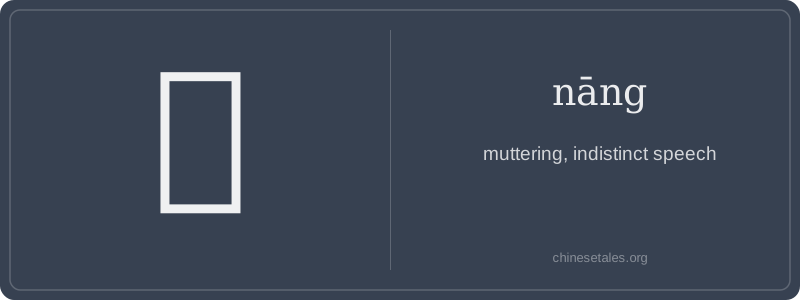
The earliest ancestor of 囔 isn’t found in oracle bones — it’s a relatively late creation, first appearing in Song dynasty dictionaries as a phonosemantic compound. Its left side 口 (kǒu, ‘mouth’) is straightforward, but the right side is a masterclass in layered borrowing: it combines 南 (nán, ‘south’) for sound + two stacked 口 (mouths) + 糸 (mì, ‘silk thread’) at the bottom — originally representing *entangled vocal cords*. Over centuries, the top 南 simplified, the double 口 fused into a squished ‘X’ shape, and the silk threads evolved into the wavy ㄙ-like stroke at the base — visually mimicking vibrating, disordered airflow.
This character was born from the need to capture *non-lexical vocalization* — not full words, but the sonic residue of thought: the hum before speaking, the murmur after forgetting. In Ming dynasty vernacular fiction like The Plum in the Golden Vase, 囔 appears when characters rehearse lies or repeat incantations absentmindedly — always with psychological weight, never mere noise. Its form is literally a mouth choked by its own sound: the radical 口 is buried under strokes that resemble knotted thread and overlapping mouths, making the character itself feel like something you have to untangle to read aloud.
Think of 囔 (nāng) as Chinese’s onomatopoeic cousin to the English ‘mumble’ — but with a distinctly *nasal*, almost childlike quality. It doesn’t just mean ‘to speak indistinctly’; it evokes speech that’s muffled, half-swallowed, or whispered under breath — like someone talking while chewing, or a toddler reciting lines they barely understand. Unlike generic verbs like 说 (shuō) or 讲 (jiǎng), 囔 is inherently *textural*: it’s always accompanied by vocal fuzziness and low volume.
Grammatically, 囔 functions almost exclusively as a verb in reduplicated form (囔回囔回 or 囔囔回), often paired with 著 (zhe) to indicate ongoing action: 他囔回囔回地念著||He mumbled repeatedly under his breath. It rarely appears alone and never takes objects directly — you don’t ‘mumble a sentence’; you ‘mumble *while* reciting’. Learners mistakenly try to use it like ‘say’ or ‘whisper’, but 囔 carries no intentional secrecy (unlike 低语 dīyǔ) — just phonetic collapse.
Culturally, 囔 appears most often in literary or descriptive writing, not daily speech — think of a novelist sketching a distracted scholar muttering half-remembered poetry, or a parent imitating their toddler’s babble. Native speakers instantly hear the ‘ng’ nasal resonance in nāng — so if you pronounce it as ‘nang’ without the rising tone, it may sound like an unintelligible grunt rather than expressive muttering. And yes: its 25 strokes are a deliberate visual echo of linguistic clutter — all those tangled components literally look like words getting stuck in your throat.