囍
Character Story & Explanation
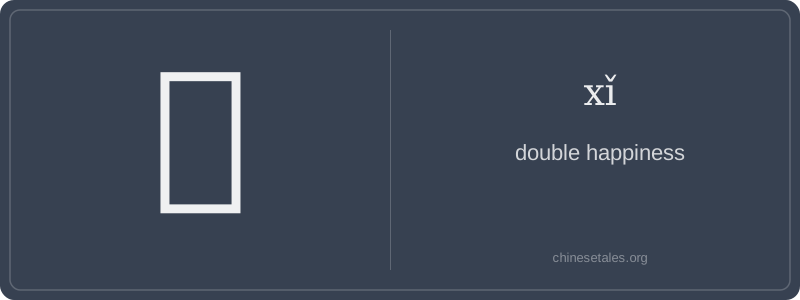
The character 囍 doesn’t exist in ancient scripts—it’s a brilliant Ming–Qing dynasty invention, born not from oracle bones or bronze inscriptions, but from calligraphic play. Its earliest known form appears in 12th-century Song dynasty marriage contracts as a stylized, mirrored duplication of 喜 (xǐ, ‘happiness’). Artists began folding red paper vertically and carving both halves simultaneously—so when unfolded, the left and right sides matched perfectly, forming a single, balanced ideogram. No stroke count? That’s intentional: it’s two identical 喜 characters fused at the vertical axis, sharing no strokes but mirroring each other flawlessly—making it the ultimate visual palindrome.
This doubling wasn’t arbitrary—it echoed Confucian ideals of paired harmony: husband/wife, yin/yang, heaven/earth. By the Qing dynasty, 囍 became mandatory decor for weddings, appearing in imperial marriage edicts and folk embroidery alike. Classical texts never mention 囍 (since it wasn’t a literary character), but its presence in poetry anthologies like the Complete Poems of the Qing appears in descriptive passages about nuptial scenes—‘red doors ablaze with twin joy’ (朱门双喜映春晖). Its meaning didn’t evolve linguistically; it exploded culturally—as a silent, radiant affirmation that happiness, when doubled, becomes sacred.
At first glance, 囍 isn’t a character you ‘read’ like others—it’s a visual talisman. Pronounced xǐ (like ‘she’ with a rising tone), it literally means ‘double happiness’, but in practice, it’s less about grammar and more about emotional resonance: it’s the red, symmetrical, celebratory heartbeat of Chinese weddings. Unlike standard characters used in daily speech or writing, 囍 almost never appears alone in prose—it doesn’t conjugate, take objects, or appear in textbooks because it’s not part of the functional lexicon. It’s a *symbol*, not a word—like drawing two hearts instead of saying ‘love’.
Grammatically, it functions as a noun or decorative compound modifier—but only in highly ritualized contexts: you’ll see it on wedding invitations (囍帖), red envelopes (囍字红包), or embroidered on bridal gowns. You won’t say ‘I 囍 this idea’ or ‘She 囍s the news’—it simply doesn’t verb. Learners often mistakenly try to use it in sentences like ‘We are 囍!’—but that’s as unnatural as shouting ‘Heart! Heart!’ at a birthday party. Instead, it’s always embedded: ‘The door has a large 囍’ (门上贴着一个大囍).
Culturally, its power lies in symmetry and doubling—a core aesthetic and philosophical value in Chinese tradition, where balance, repetition, and auspicious redundancy signal cosmic harmony. Mistaking it for a ‘real’ character leads to awkward overuse; respecting it as a ceremonial glyph unlocks deeper understanding of how language, art, and ritual intertwine in Chinese life.