呓
Character Story & Explanation
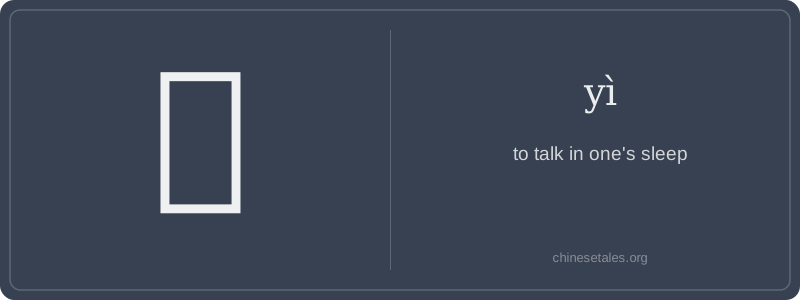
The earliest form of 呓 appears in seal script (c. 3rd century BCE), where it combined 口 (kǒu, 'mouth') on the left with 乙 (yǐ, originally a pictograph of a bent, writhing worm or coiling dragon — symbolizing fluid, unconscious movement). The 乙 component wasn’t arbitrary: in ancient Chinese cosmology, 乙 represented the second of the Ten Heavenly Stems and carried associations with softness, flexibility, and the liminal — perfect for depicting speech that slips out unbidden, like mist rising from still water. Over centuries, the 乙 simplified into its modern hook-and-curve shape, while 口 retained its clear mouth outline — together forming a compact, elegant glyph of involuntary vocalization.
This visual logic deepened in meaning during the Tang and Song dynasties, when poets like Bai Juyi and medical texts like the Compendium of Materia Medica used 呓 to describe not just physical muttering, but the soul’s ‘unfiltered voice’ during deep slumber. Its inclusion in classical dream-interpretation manuals reinforced its link to subconscious revelation — a nuance preserved today in phrases like 呓语成真 (yì yǔ chéng zhēn, 'a sleep-muttering comes true'), suggesting latent desires manifesting. The character’s quiet elegance masks its rich psycholinguistic heritage — seven strokes holding millennia of dream lore.
Think of 呓 (yì) as Chinese’s version of 'sleep-talking' — but with a linguistic twist that feels almost Shakespearean: it doesn’t just describe the act; it evokes the eerie, involuntary poetry of the unconscious mind. Unlike English’s neutral 'talking in your sleep', 呓 carries subtle literary weight — it implies fragmented, nonsensical, or emotionally charged utterances, often hinting at hidden feelings bubbling up from dreams. You’ll rarely hear it in casual speech ('He was mumbling something' would use 念叨 or 含糊说), but you *will* see it in novels, psychological essays, or medical contexts describing parasomnias.
Grammatically, 呓 is almost always used in compound verbs like 呓语 (yì yǔ, 'sleep-talking') or as a verb in formal/compound structures: 呓出 (yì chū, 'to blurt out in sleep'), 呓说 (yì shuō, 'to mutter while asleep'). It’s never used alone as a standalone verb — saying *‘他呓’ is ungrammatical. Instead, it must be paired: 他开始呓语 (tā kāishǐ yì yǔ, 'He began sleep-talking'). Note the tone: yì is fourth tone — sharp and falling, like a sudden gasp mid-dream.
Culturally, 呓 subtly echoes ancient Chinese beliefs about dreams as portals to the soul’s truth. In classical texts, unguarded nighttime speech was seen as revealing one’s authentic self — making 呓 more psychologically loaded than its English counterpart. Learners often mispronounce it as yī (first tone) or confuse it with 意 (yì, 'meaning'), but remember: 口 (mouth) + 乙 (a curved, dreamlike stroke) = mouth moving without conscious control — not intention.