冁
Character Story & Explanation
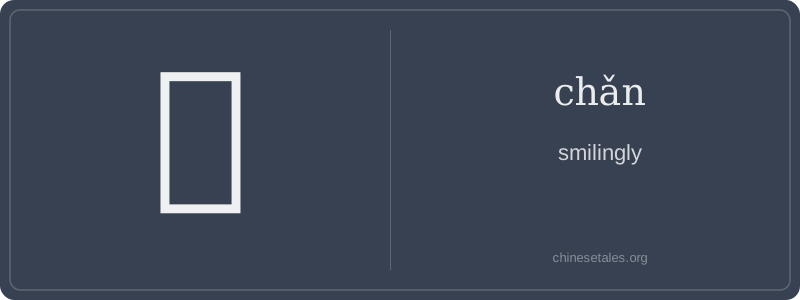
Carve this into your mind: the earliest form of 冁 (in bronze inscriptions) wasn’t a smile at all — it was a stylized depiction of a person *unfolding their arms wide*, with emphasis on open palms and relaxed shoulders — a gesture of welcoming, release, or joyful surrender. Over centuries, the left side simplified into 丷 (a common phonetic marker for ch- sounds), while the right evolved from 展 (itself built from 尸 'person' + 衤 'clothing' + 'to stretch') — preserving the core idea of 'unfolding'. By the Han dynasty, the character stabilized as 冁, its 18 strokes deliberately intricate to mirror the complexity of genuine, unguarded delight.
This evolution mirrors its semantic journey: from physical openness → emotional expansiveness → luminous, expressive joy. It appears memorably in the Song dynasty poet Mei Yaochen’s line: '冁然一笑百忧散' ('One radiant smile scatters a hundred worries') — where the character doesn’t just describe smiling, but *embodies* the transformative power of that smile. Visually, those 18 strokes aren’t decorative — they’re the 'crinkles' around the eyes, the lift of the cheeks, the gentle parting of lips — all rendered in ink. It’s calligraphy as emotion captured mid-bloom.
Let’s crack open 冁 (chǎn) like a rare antique scroll — it’s not just 'smilingly'; it’s the *radiant, unrestrained, almost luminous* smile that breaks across someone’s face like sunlight through clouds. This isn’t a polite grin or a quick smirk — it’s the kind of smile that crinkles the eyes, lifts the cheeks, and feels emotionally generous, even tender. In classical and literary Chinese, 冁 carries warmth and sincerity, often describing spontaneous joy in response to kindness, beauty, or relief.
Grammatically, 冁 is an adverb — always modifying a verb (especially 笑, 'to laugh/smile') — and appears almost exclusively in written, formal, or poetic registers. You’ll *never* hear it in casual speech or beginner textbooks; it’s the velvet glove on a scholar’s hand. Example: '她冁然一笑' — not 'she smiled', but 'she beamed forth a radiant, heart-lifting smile'. Learners mistakenly treat it like modern adverbs (e.g., 慢慢地), but 冁 stands alone — no 的 needed, no colloquial variants. It’s fossilized elegance.
Culturally, 冁 evokes Confucian ideals of harmonious, unforced joy — the kind that arises from moral resonance, not mere amusement. Mistake it for a generic 'smile' word, and you’ll sound oddly archaic or unintentionally theatrical. Also beware: its radical 丷 (bā, 'eight') has *zero semantic role* here — it’s purely phonetic scaffolding. The real action is in the right side: 展 (zhǎn, 'to unfold'), which visually echoes how a smile 'unfurls' across the face. That’s the secret: 冁 isn’t about the mouth — it’s about the whole expression *blooming*.