嗫
Character Story & Explanation
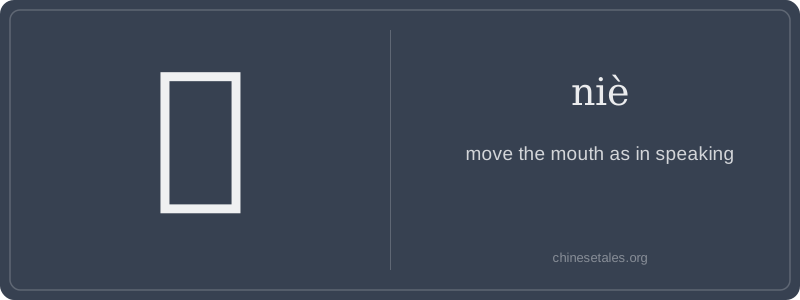
The earliest trace of 嗫 appears not in oracle bone script, but in late Warring States bronze inscriptions and early clerical script, where it emerges as a compound of 口 (kǒu, 'mouth') and 摄 (shè, 'to grasp, collect'), later simplified to 耳 (ěr, 'ear') + 摄’s top component. Its current form crystallized by the Han dynasty: left side 口 anchors it to speech, while the right side — a stylized fusion of 耳 (ear) and 摄’s hand-like grip — suggests the mouth ‘grasping’ or ‘controlling’ sound *before* release. The 13 strokes map precisely to this tension: three for the mouth frame, ten for the intricate, restraining gesture beside it.
By the Tang and Song dynasties, 嗫 had settled into its literary niche, appearing in texts like the Guwen Guanzhi to depict characters who ‘moved lips but uttered nothing’ — not silence, but *pre-silence*. Classical poets used it to contrast inner turmoil with outward restraint, linking mouth movement to moral hesitation. Its visual structure — mouth plus ‘gripping ear’ — subtly implies listening to oneself *while* preparing to speak, making it uniquely introspective among mouth-related characters.
At its heart, 嗫 (niè) is a quiet, fidgety character — it doesn’t shout or declare; it *flickers*. It captures the tiny, involuntary mouth movements people make before speaking: lips parting, tongue shifting, breath catching — that hesitant, almost subconscious prelude to sound. Think of someone rehearsing a difficult sentence under their breath, or nervously mumbling to themselves in an empty room. It’s not about full speech (that’s 说 shuō), nor whispering ( whisper is 低语 dīyǔ), but the physical *twitch* of articulation — a linguistic micro-gesture.
Grammatically, 嗫 is almost never used alone. It appears almost exclusively in fixed compound verbs like 嗫嚅 (niè rú) or 嗫嚅不言 (niè rú bù yán), always paired and almost always with a sense of inhibition — hesitation, timidity, or suppressed speech. You’ll rarely see it in modern spoken Mandarin; it lives in literary description, psychological narration, or classical-influenced prose. Learners sometimes mistakenly try to use it like a verb meaning 'to speak softly' — but it’s not functional on its own; it’s a *visual metaphor*, not a working verb.
Culturally, 嗫 carries subtle weight: it evokes social unease, power imbalance, or internal conflict — the kind of silence where words are present but choked. It’s often used to describe subordinates avoiding direct address, children afraid to answer, or characters wrestling with confession. A common mistake is overgeneralizing it to any quiet speech; remember: if there’s no visible, nervous lip/tongue movement implied — it’s probably not 嗫.