啭
Character Story & Explanation
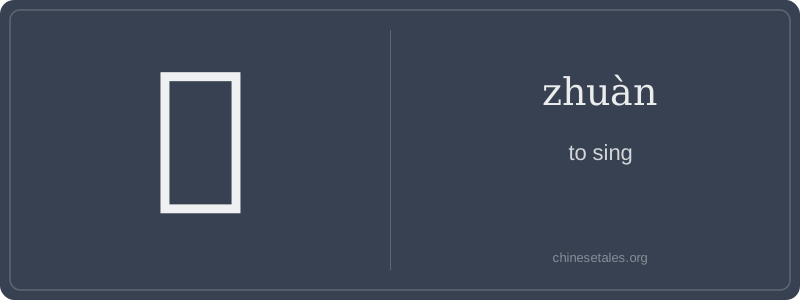
The earliest trace of 啭 appears not in oracle bones, but in late Warring States bamboo slips and Han dynasty seal script — and its structure tells a clear tale. The left side 口 (kǒu, ‘mouth’) is straightforward: the domain of voice. The right side is the key: it’s a stylized variant of 專 (zhuān), an ancient character meaning ‘to focus intently’ or ‘to coil tightly’ — originally picturing hands turning a spindle. Over centuries, 專 simplified and merged visually with other elements, eventually becoming the 9-stroke component on 啭’s right. Crucially, this wasn’t arbitrary: the ‘coiling’ idea evoked the *winding, spiraling quality of a bird’s trill* — not straight melody, but sound that curls upward, repeats, and loops with delicate tension.
This visual logic cemented its meaning early. By the Tang dynasty, 啭 appears in poetry describing nightingales and orioles — Li Bai’s contemporaries used it to contrast raw human shouting (hǒu) with the refined, controlled, almost meditative act of avian vocal artistry. In the 12th-century *Yunlüe* rhyme dictionary, 啭 is explicitly defined as ‘bird call with rising inflection and rhythmic repetition.’ Even today, its shape — mouth + coiled focus — whispers: ‘voice, precisely wound, lifting like a thread of silk.’
At first glance, 啭 (zhuàn) feels like a poetic cousin of more common 'sing' words like 唱 (chàng) — but it’s far more specific and evocative. It doesn’t mean singing in general; it describes the *flourishing, melodic, often high-pitched vocalization* of birds or, by extension, people imitating that light, trilling quality — think warbling, chirruping, or caroling with delicate ornamentation. You’ll almost never hear it used for pop singers belting out ballads; it belongs to larks at dawn, opera sopranos executing a rapid roulade, or even a child’s gleeful, lilting laugh.
Grammatically, 啭 is almost always a verb — and a vivid one at that — used in literary, descriptive, or artistic contexts. It rarely stands alone: you’ll see it in compounds (like 啭鸣 or 啭唱) or paired with adverbs like 清脆地 (qīngcuì de, 'crisply') or 悦耳地 (yuè’ěr de, 'melodiously'). Unlike 唱, it’s not used transitively with objects (you don’t ‘sing a song’ with 啭); instead, it’s intransitive and sensory-driven: the bird 啭, the throat 啭, the air seems to 啭. A classic learner mistake is forcing 啭 into everyday speech — it sounds oddly ornate or archaic if dropped into casual chat like ‘I’ll 啭 a song later.’
Culturally, 啭 reflects a deep Chinese aesthetic appreciation for *natural sonic texture*: not just what is sung, but *how* it vibrates — the timbre, the lift, the flutter. In classical poetry and qin music criticism, this kind of vocal nuance was tied to qi (vital energy) and xìng (innate nature). Modern usage remains rare outside literature, nature writing, or refined performance arts — which is why it’s absent from HSK. Its scarcity isn’t about difficulty, but about precision: Chinese reserves 啭 for moments when sound itself becomes a living, breathing thing.