嘤
Character Story & Explanation
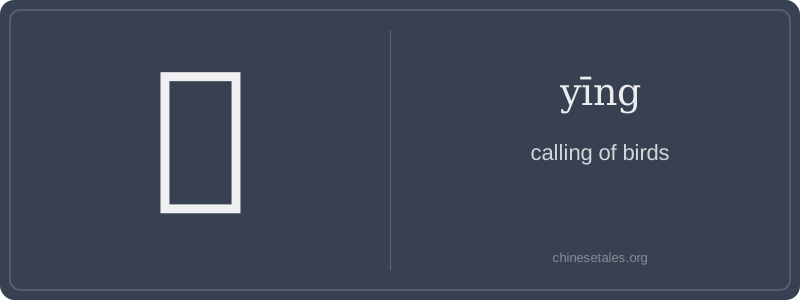
The earliest trace of 嘤 appears not in oracle bones but in late Warring States bamboo texts and Han dynasty dictionaries, where it’s already phonosemantic: 口 (kǒu, ‘mouth’/‘sound’) on the left signals vocalization, and 罌 (yīng, a variant of 罂 — originally a tall jar with narrow neck) on the right serves purely as a phonetic clue. Wait — a *jar* for a bird call? Yes! Ancient phonetics often borrowed unrelated shapes just for their sound. The right side evolved from 罌’s complex form (罒 + 缶 + two strokes) into today’s simplified 罂-like shape — losing its jar meaning entirely but preserving the yīng sound.
This character bloomed in classical poetry: the Shījīng (Book of Odes) uses 嘤嚶 to describe harmonious bird calls symbolizing virtuous friendship — ‘when birds call 嘤嚶, good men gather’. Later, Tang poets like Wang Wei used 嘤 to evoke serene emptiness — one line reads ‘mountain light falls silent; only birds 嘤 in the pines’. Its visual rhythm — compact mouth radical plus flowing, slightly top-heavy right side — mirrors how the sound feels: small opening (口), then a soft, rising, lingering resonance (yīng).
Think of 嘤 (yīng) as the Chinese onomatopoeic whisper of birdsong — not loud or shrill, but soft, delicate, almost tender: a tiny warble at dawn, a shy chirp from a hidden branch. It’s not about *any* bird sound — it’s specifically the gentle, melodic, often plaintive call that evokes solitude or quiet beauty. You’ll rarely hear it in everyday speech; it lives in poetry, classical allusions, and literary descriptions where mood matters more than meaning.
Grammatically, 嘤 is almost always used reduplicatively (嘖嘖 → 嘤嘤) or paired with other onomatopoeic characters like 嘤嚶 (yīng yīng), functioning as an adverbial phrase or standalone interjection. It doesn’t take objects or verbs — it *floats*, modifying atmosphere: 'the garden was filled with 嘤嚶' means ‘filled with soft, continuous bird calls’, not ‘birds were calling’. Learners sometimes mistakenly treat it like a verb (e.g., ‘birds yīng’), but it’s never conjugated — it’s pure sonic texture.
Culturally, 嘤 carries poetic melancholy — think of a lone scholar in a bamboo grove hearing faint, distant calls, symbolizing gentle longing or refined solitude. It’s absent from HSK because it’s ornamental, not functional. A common mistake? Confusing it with 應 (yìng, ‘to respond’) — same sound, totally unrelated meaning and structure. Don’t force it into conversation; let it nestle into your reading like a feather in ink.