嚵
Character Story & Explanation
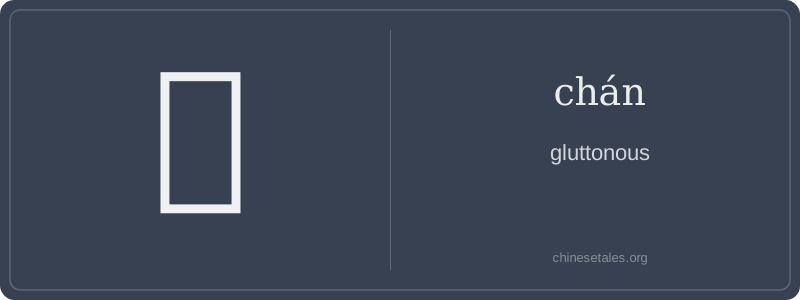
Oracle bone and bronze script forms of 嚵 don’t survive — it’s a later character, first appearing in seal script during the Warring States period. Its structure is brilliantly literal: left side 口 (kǒu, 'mouth'), right side 毚 (chán), a phonetic component that itself evolved from a pictograph of a hare (兔) with added elements suggesting speed and stealth. Over centuries, the right side simplified into its current form — three stacked 'mouths' (吅) above 兔 — visually echoing frantic, overlapping eating motions. The whole character became a kinetic portrait of mouths devouring without pause.
By the Han dynasty, 嚵 was already entrenched in classical texts as a descriptor of moral excess. In the Shuōwén Jiězì (121 CE), Xu Shen defined it as 'excessively fond of eating', linking it to the Confucian virtue of moderation. Tang poets like Du Fu used it ironically: 'His 嚵 belly swells like a drum' — mocking aristocratic decadence. Even today, its visual density (18 strokes!) mirrors its semantic weight: every stroke feels like another bite taken too eagerly.
Think of 嚵 (chán) as the Chinese language’s vivid, slightly theatrical word for 'gluttonous' — not just 'hungry', but insatiably, almost comically overeager to eat. It carries a strong tone of moral judgment or playful exaggeration: someone who devours food (or sometimes even knowledge or attention) with unrestrained, almost animal-like appetite. You’ll rarely see it in neutral descriptions — it’s poetic, literary, or mildly mocking. It’s almost always an adjective, used before nouns (嚵相 chán xiàng, 'gluttonous appearance') or in fixed phrases like 嚵嘴 (chán zuǐ, 'greedy mouth').
Grammatically, it’s not used predicatively like modern adjectives (you wouldn’t say 'He is 嚵'); instead, it modifies nouns or appears in compound words. Learners often mistakenly treat it like common adjectives such as 饿 (è, 'hungry') or 贪 (tān, 'greedy'), but 嚵 is far more stylistic and archaic — it’s the kind of word you’d find in classical poetry or satirical essays, not in daily conversation or HSK textbooks. Its rarity makes it a delightful 'deep cut' for advanced learners.
Culturally, 嚵 evokes Daoist and Buddhist critiques of excess — think of Zhuangzi’s parables about insatiable desire, or Tang dynasty poets lampooning courtiers gorging at banquets. A common mistake? Confusing it with 谗 (chán, 'slanderous'), which sounds identical but has a completely different meaning and radical. Remember: 嚵 is *mouth*-driven hunger; 谗 is *speech*-driven harm. Pronunciation note: In rare dialectal or historical contexts, it may surface as chàn — but for all practical purposes, stick with chán.