亸
Character Story & Explanation
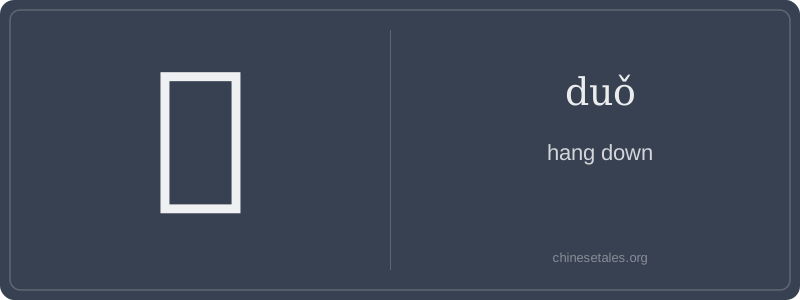
The earliest form of 亸 appears in late clerical script (Lìshū), evolving from a fusion of two elements: the top 亠 (tóu, 'head') and the bottom 垂 (chuí, 'to hang down'). Crucially, 垂 itself began as a pictograph in oracle bone inscriptions — three curved lines beneath a horizontal stroke, vividly depicting long hair or ropes sagging under gravity. Over centuries, the lower part simplified and stylized, while the upper 亠 subtly suggested the head from which the hair or sleeves descend — making 亸 a masterclass in semantic layering: 'head + hanging' = the very image of weary elegance.
This visual logic anchored its meaning across dynasties. In the Tang poem 'Jade Terrace New Odes', 亸 describes a courtesan’s loosened coiffure — not disorder, but deliberate, poignant softness. By the Song, it appeared in landscape poetry ('柳亸' liǔ duǒ, 'willows hanging') to evoke spring’s tender surrender to wind. Its form never changed drastically because its meaning was too perfectly fused: each stroke feels like a slow, downward curve — no sharp angles, no haste. Even today, seeing 亸 on the page makes your shoulders drop slightly. That’s not coincidence — it’s calligraphy as embodied emotion.
At its heart, 亸 (duǒ) is a poetic verb meaning 'to hang down loosely' — think of hair slipping from a bun, sleeves drooping over tired hands, or willow branches swaying low. It’s not just physical descent; it carries quiet melancholy, weariness, or gentle surrender. You won’t hear it in daily chatter — it’s a literary whisper, preserved in classical poetry and refined prose, where every character must earn its place with emotional precision.
Grammatically, 亸 functions as an intransitive verb, almost always appearing in descriptive, rhythmic phrases: '鬓亸' (bìn duǒ, hair hanging beside the temple), '袖亸' (xiù duǒ, sleeves drooping), or '亸着头' (duǒ zhe tóu, head hanging down). Note the 'zhe' construction — learners often mistakenly treat it like modern verbs (e.g., *duǒ le*), but 亸 rarely takes aspect markers; its power lies in its static, suspended quality — no past, no completion, just lingering descent.
Culturally, 亸 reflects the Chinese aesthetic of *yùn wèi* (lingering resonance): beauty in imperfection, grace in fatigue, dignity in softness. Mistake it for generic 'hang' (挂 guà) or 'drop' (掉 diào), and you lose that hushed, lyrical weight. Also — beware: its radical is 亠 (tóu), not 扌 or 木, so it’s about posture and state, not action or object. Learners who force it into colloquial sentences sound like Tang dynasty poets accidentally time-traveling to a Beijing subway.