嚯
Character Story & Explanation
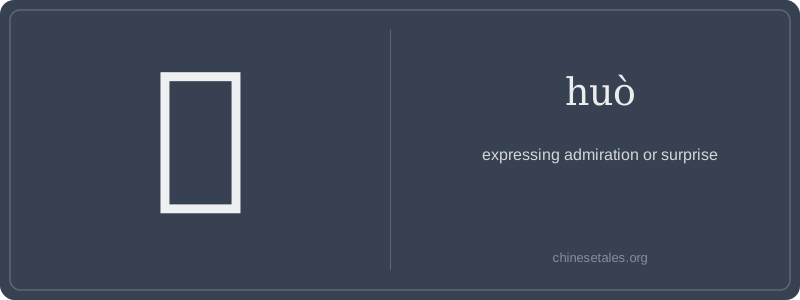
The earliest ancestor of 嚯 isn’t found in oracle bones — it’s a relatively late creation, emerging in the late imperial era as a phonosemantic compound. Its left side, 口 (kǒu), is the universal ‘mouth’ radical — no mystery there. The right side, 霍 (huò), is the real star: originally picturing rain falling through dense grass (雨 + 隹 + 草-like elements), it evoked sudden, shimmering movement — like light flickering across wet reeds. Over centuries, 霍 simplified, losing its avian and vegetal flourishes, until only its crisp, staccato sound and sense of abrupt brilliance remained.
This visual origin — rain-light flashing through tall grass — fused perfectly with oral expression: the quick, bright, involuntary exhalation of surprise. By the Qing dynasty, 嚯 appeared in vernacular novels like *The Scholars*, where characters burst out ‘嚯!’ upon witnessing absurd social pretension — not just shock, but *recognition* of something dazzlingly incongruous. Its 19 strokes aren’t arbitrary: they mimic the physical effort of that sharp, open-mouthed expulsion — tongue low, jaw wide, breath released like a sudden gust through reeds.
Think of 嚯 (huò) as Chinese onomatopoeia’s charismatic show-off — it doesn’t describe something; it *performs* a feeling. It’s the sharp, breathy gasp you make when someone reveals a dazzling magic trick, drops an unexpected truth bomb, or unveils a stunning sunset: 'Huo—!' Not quite a word, not quite a grunt — more like linguistic confetti. It carries admiration, astonishment, and delighted surprise all at once, often with a hint of playful irony or wry appreciation.
Grammatically, 嚯 is almost always used as an interjection — standalone, sentence-initial, and emphatic. You’ll rarely see it embedded mid-sentence or modified by particles. It’s shouted, whispered, or drawn out for effect: ‘嚯!这幅画是您自己画的?’ (Huò! Zhè fú huà shì nín zìjǐ huà de?) — ‘Whoa! Did *you* paint this?’ Learners sometimes try to use it like English ‘wow’ in compound phrases (e.g., ‘very 嚯’), but that’s impossible — it has no adjective form, no verb derivation, and zero tolerance for modifiers.
Culturally, 嚯 thrives in spoken, informal contexts — especially among older generations or in northern dialects — where vocal texture matters more than lexical precision. It’s absent from formal writing and rare in textbooks (hence its HSK absence), which trips up learners expecting textbook vocabulary. A common mistake? Confusing it with written exclamations like 啊 (ā) or 哇 (wā); those are softer and more versatile, while 嚯 is brash, rhythmic, and distinctly ‘mouthy’ — fitting, given its 口 radical and 19-stroke visual heft.