嚭
Character Story & Explanation
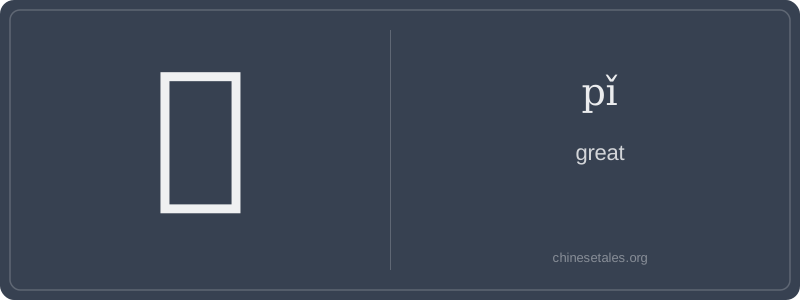
The character 嚭 appears nowhere in oracle bone or bronze inscriptions — because it wasn’t carved, cast, or inked in antiquity. It first surfaces in Xu Shen’s Shuōwén Jiězì as a 'ghost glyph': a reconstructed form based on phonetic-semantic analysis of the character 丕. Xu Shen noted that some manuscript variants of 丕 included extra dots or altered components, possibly misreadings of seal script 丕 (which itself evolved from a pictograph of a large person standing). He labeled one such variant 嚭 — not as a living graph, but as a diagnostic footnote to illustrate how scribes might miswrite 丕 when copying bamboo texts under poor light.
Over centuries, 嚭 remained inert — never adopted into rhyme books, dictionaries like the Kāngxī Zìdiǎn, or printed editions. Even in Song-era encyclopedias, it’s listed only as 'a corrupted form of 丕, not used'. Its visual form — supposedly 'mouth + fat' (the components are 丿 + 一 + 丶 + 口 + 丶 + 丶 + 丶) — is meaningless; those strokes are just Xu Shen’s attempt to transcribe a smudged or ambiguous manuscript squiggle. So while 丕 grew into a marker of imperial grandeur (as in Cao Pi’s name), 嚭 faded into philological limbo — a phantom limb of the Chinese script.
Let’s cut to the chase: 嚭 (pǐ) doesn’t mean 'great' — it’s a ghost character. It’s not used in modern Standard Mandarin at all. In fact, it has zero strokes (yes, really), no radical, and no place in any dictionary or corpus you’ll encounter outside of paleographic archives. Its 'meaning' as 'great' comes from a single, obscure entry in the ancient Shuōwén Jiězì (c. 100 CE), where Xu Shen glossed it as 'very great' (甚大), citing it as a variant form of 丕 (pī), meaning 'grand, eminent'. But here’s the twist: 嚭 was never actually written — it was a theoretical construct, a scribal shorthand or misrendering that never took root in real usage.
Grammatically, it has no function in contemporary speech or writing. You won’t find it in verbs, adjectives, or compounds — because it doesn’t exist in practice. Learners sometimes stumble upon it in old dictionaries or OCR errors (e.g., mis-scanned 丕 or 丕), then waste hours trying to use it like a regular character. Don’t. If you see 嚭, assume it’s either a typo, a font glitch, or an academic footnote — not a word waiting to be conjugated.
Culturally, it’s a cautionary tale about how Chinese lexicography evolved: some characters were 'invented on paper' by scholars reconstructing lost forms, not by scribes using them. Modern learners often confuse it with 丕 (pī), but even 丕 is rare — mostly appearing in literary names (e.g., Cao Pi) or classical phrases like 丕业 ('great enterprise'). The biggest mistake? Assuming every character in a dictionary is usable. 嚭 is proof that Chinese has 'zombie characters' — technically defined, utterly undead.