呖
Character Story & Explanation
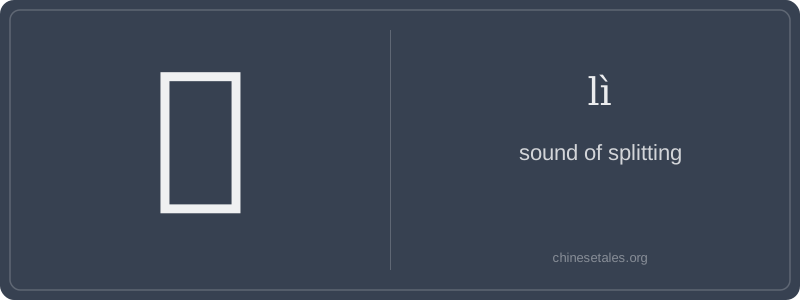
The earliest trace of 呖 appears not in oracle bone script (where it’s absent), but in late Warring States bronze inscriptions and early seal script, where it emerges as a compound: the ‘mouth’ radical 口 on the left — signaling speech or sound — fused with a simplified form of 立 (lì, to stand), written with three horizontal strokes above two short verticals. Over centuries, 立 streamlined into the top-right component: 丨 (a single stroke) + 丶 (dot) + 一 (horizontal), mirroring the visual economy of small, sharp rupture — like a tiny fissure appearing upright and sudden. The 口 radical didn’t mean ‘mouth’ here literally, but acted as a semantic classifier for vocalized or audible phenomena — much like how ‘splash’ in English implies water, even if said silently.
This visual logic carried straight into meaning: the upright ‘split’ shape (立’s essence, repurposed) inside the ‘sound’ frame (口) evoked the instant a thing parts — not the act, but the *audible signature* of separation. By the Han dynasty, 呖 was already fixed in texts like the Shuōwén Jiězì as ‘the sound of splitting’, used in descriptions of cracking ice or rending cloth. Its usage remained stable for two millennia — never broadening, never fading — a testament to Chinese’s capacity to preserve hyper-specific sensory vocabulary, even when unused in daily talk.
At first glance, 呖 (lì) feels like a whisper from the margins of Chinese — not in HSK, rarely in textbooks, and almost never in daily speech. But don’t mistake its rarity for irrelevance: it’s a tightly focused *onomatopoeic* character, capturing one very specific auditory sensation: the sharp, clean, almost brittle sound of something splitting or tearing — think bamboo snapping, silk ripping, or ice cracking under sudden pressure. It’s not a general ‘sound’ word like 叫 (jiào, to shout) or 响 (xiǎng, to ring); it’s a sonic scalpel.
Grammatically, 呖 functions exclusively as an interjection or descriptive adverbial particle — always paired with other verbs or embedded in literary onomatopoeic phrases. You’ll never say ‘I 呖’ — instead, you’ll hear it in vivid, rhythmic sequences like ‘噼里啪啦’ (pī lī pā lā), where 呖 contributes the crisp, mid-pitch ‘lì’ snap between the sharper ‘pī’ and softer ‘pā’. It’s almost always reduplicated or compounded; standalone use is archaic or poetic. Learners often misread it as ‘li’ without tone (missing the fourth tone’s falling urgency) or confuse it with homophones like 力 (lì, strength) — but 呖 isn’t about force, it’s about fracture’s *sound*.
Culturally, 呖 belongs to the elegant, sensory-rich tradition of classical Chinese onomatopoeia — where sound words weren’t just noise, but poetic texture. In Tang dynasty poetry or Ming vernacular fiction, such characters added visceral immediacy. Modern learners rarely encounter it outside compound words or stylistic writing — which makes mastering it a quiet badge of linguistic sensitivity. Don’t try to ‘use’ it conversationally; instead, savor it as a sonic artifact — proof that Chinese once carved distinct glyphs for the precise timbre of a breaking twig.