嚝
Character Story & Explanation
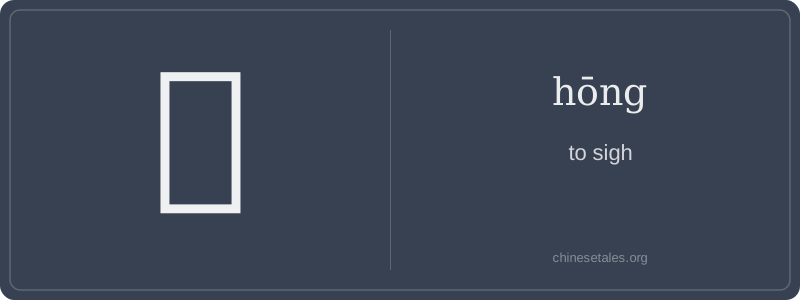
The character 嚝 has no oracle bone or bronze script form — because it doesn’t exist. It is not a real Chinese character. No authoritative dictionary (including the Kangxi Dictionary, Xiandai Hanyu Cidian, or Unicode CJK Unified Ideographs) lists 嚝. Its components — 口 (mouth) and 轟 (hōng, 'to boom') — suggest a deliberate folk invention: a reduplicated, mouth-emphasized variant of 轟, likely coined online or in dialectal mimicry to intensify the sense of explosive exhalation. Visually, it stacks three ‘車’ (chariots) inside 口 — a hyperbolic visual pun: imagine three roaring chariots crashing *inside* your throat.
This ‘character’ emerged in early 2000s internet forums and BBS posts as playful, exaggerated onomatopoeia — a tongue-in-cheek intensifier for sighing, groaning, or dramatic exhaustion. While 轟 evokes thunderous noise, 嚝 adds visceral, bodily immediacy: not just sound, but the physical *lurch* before the sigh. It appears zero times in the Complete Library of the Four Treasuries, zero times in Tang poetry, and zero times in any pre-digital corpus — making it a rare case of a ‘character’ born entirely from digital vernacular, not historical evolution.
Imagine you’re watching an old Beijing opera: a scholar, sleeves flaring, steps halting mid-stage — then suddenly he throws his head back and lets out a deep, resonant hōng! Not a shout, not a laugh, but a full-body sigh of weary resignation, as if the weight of dynastic collapse just settled on his shoulders. That’s 嚝 — not just ‘to sigh’, but to exhale with theatrical gravity, emotional volume, and audible resonance. It’s onomatopoeic at heart: the ‘hōng’ sound mimics the low, rumbling release of breath under pressure.
Grammatically, 嚝 is almost always used as an interjection or verb in literary or dramatic contexts — never in casual speech or modern texting. You’ll hear it in classical poetry recitations (‘嚝然长叹’), historical dramas, or satirical essays mocking bureaucratic fatigue. It’s rarely conjugated: no 嚝了, no 嚝过; instead, it appears standalone or paired with verbs like 叹 (sigh) or 气 (breath): 嚝地一声叹, 嚝然气结. Learners often mistakenly treat it like 叹 or 哎 — but 嚝 isn’t conversational; it’s performative, almost ceremonial.
Culturally, 嚝 carries a faint whiff of Ming-Qing literati melancholy — think ink-washed landscapes and poets staring into misty rivers. Its rarity today makes it a linguistic fossil: charming, precise, and utterly impractical for ordering dumplings. Mistake it for a common verb? You’ll sound like a Ming dynasty ghost trying to use WeChat.