嚚
Character Story & Explanation
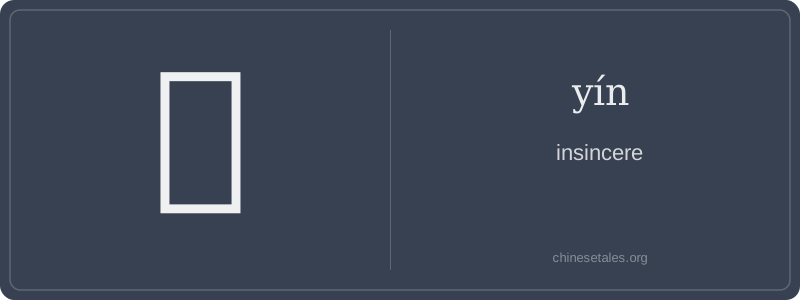
The earliest form of 嚚 appears in bronze inscriptions as a complex glyph combining 口 (mouth) with a distorted, angular element resembling two crossed arms or a bound figure — possibly depicting someone speaking while physically restrained or internally conflicted. Over centuries, the upper part evolved into the phonetic component 禋 (yīn, an ancient ritual term), while the lower 口 remained, anchoring the meaning to speech. By the Han dynasty, the character stabilized into its current shape: a tightly packed 18-stroke structure where the mouth radical sits beneath a dense, cage-like upper component — visually echoing the idea of words trapped behind artifice.
This visual tension shaped its semantic journey: from early texts like the *Shu Jing* (Book of Documents), where 嚚 described rulers whose decrees sounded righteous but concealed tyranny, to Tang dynasty poetry, where poets used it to critique sycophantic courtiers. Unlike similar terms like 伪 (wěi, 'false'), which implies deliberate fabrication, 嚚 suggests a deeper moral failure — the speaker believes their own performance, blurring the line between deceit and self-deception. Its rarity today reflects how Chinese discourse shifted toward more direct terms for dishonesty — leaving 嚚 as a fossilized, almost poetic, accusation of performative virtue.
Imagine you're at a lavish banquet in ancient Chang'an, where a court official bows deeply and declares his 'utter devotion' to the emperor — but his eyes flick sideways toward the rival minister's seat, and his smile doesn’t reach his knuckles. That’s 嚚 (yín): not outright lying, but a performance of sincerity so polished it curdles into something hollow. It’s the linguistic equivalent of silk gloves hiding clenched fists — describing speech or behavior that’s technically respectful, even eloquent, yet fundamentally disingenuous, calculated to flatter or manipulate.
Grammatically, 嚚 is almost always an adjective modifying nouns (e.g., 嚚言 yín yán — 'insincere words') or used in literary compounds; it rarely stands alone in modern speech and never functions as a verb. You won’t hear '他很嚚' in casual chat — it’s too archaic and judgmental. Instead, it appears in classical-style critique: '其辞嚚而貌恭' ('His words are insincere, though his bearing is deferential'). Learners often misread it as 'loud' or 'noisy' because of the mouth radical (口), but 嚚 has zero to do with volume — it’s about moral texture, not decibels.
Culturally, 嚚 carries Confucian weight: sincerity (诚 chéng) is foundational to virtue, so labeling someone as 嚚 is a quiet, devastating moral indictment — like calling someone 'untrustworthy' in a society where reputation is your currency. Mistake it for 易 (yì, 'easy') or 银 (yín, 'silver'), and you’ll accidentally accuse someone of being 'silver-sincere' or 'easy-insincere'. It’s rare, formal, and reserved for written moral commentary — not texting your friend about a fake apology.