啮
Character Story & Explanation
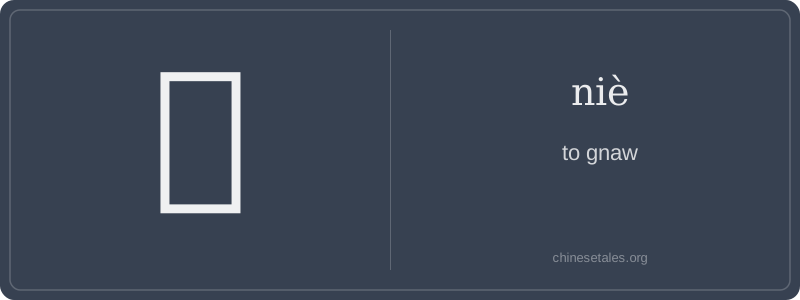
The earliest form of 啮 appears in bronze inscriptions as a composite: a mouth radical (口) on the left, and on the right, a stylized depiction of interlocking teeth—originally drawn with jagged, opposing lines suggesting upper and lower incisors grinding together. Over centuries, the right side evolved from pictographic teeth into the modern 又 + 木 structure: 又 (a hand-like component hinting at repeated action) fused with 木 (wood), subtly reinforcing the idea of teeth working *on* something hard and fibrous. By the Han dynasty, the shape stabilized into today’s 11-stroke form—still unmistakably mouth-driven, but now encoded with motion and resistance.
This visual logic shaped its meaning from the start: not mere ingestion, but focused, abrasive consumption. In the *Zuo Zhuan*, 啮 appears describing rats gnawing palace beams—a portent of decay. Later, in Tang poetry, it became metaphorical: ‘sorrow gnaws the heart’ (*chóu sī rú shé nìe xīn*), where the physical act mirrors psychological attrition. The character never softened—its mouth radical anchors it in bodily action, while its right side insists on effort, friction, and gradual change. It’s a rare case where form, sound (niè echoes the sharp ‘n-’ and clipped ‘-iè’), and semantic history align with uncanny precision.
Imagine a field mouse under moonlight, tiny teeth scraping insistently at a hard acorn shell—*not* chewing it down in bites, but *gnawing*: slow, persistent, rhythmic, almost obsessive. That’s 啮 (niè). It’s not casual eating; it’s the gritty, repetitive action of teeth working against resistance—wood, bone, metal, even abstract things like time or sorrow. In Chinese, 啮 is almost always transitive and vividly physical: you *nìe* something specific, and the verb carries weight, often implying wear, erosion, or quiet persistence.
Grammatically, it’s formal and literary—rare in daily speech but alive in writing, science, and classical allusions. You’ll see it in biology texts (*shǔ lèi yǒu néng nìe yìng wù de yá chǐ* — rodents have teeth that gnaw hard substances), or in poetic metaphors (*yōu chóu rú shé nìe xīn* — sorrow gnaws at the heart). Learners often misapply it as a general synonym for ‘eat’—but using 啮 for ‘I ate an apple’ sounds bizarrely violent and archaic. Reserve it for when teeth meet tough resistance—or when metaphor demands visceral texture.
Culturally, 啮 evokes endurance and quiet destruction: think of termites nibbling rafters over decades, or Confucius’ lament about virtue eroded by petty habits—‘like rats gnawing the beam.’ Mistake it for milder verbs like 吃 (chī) or 咬 (yǎo), and you’ll unintentionally inject grim, almost gothic intensity into your sentence. It’s a character that doesn’t just describe action—it summons atmosphere.