嚗
Character Story & Explanation
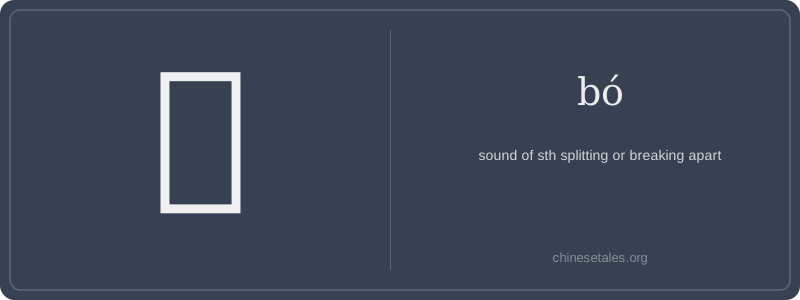
The earliest trace of 嚗 isn’t in oracle bones—it’s a late creation, first attested in Ming dynasty vernacular fiction manuscripts. Visually, it’s a masterclass in phonosemantic fusion: left side 口 (kǒu, ‘mouth’) signals it’s a sound; right side 曝 (pù, ‘to expose to sun’) provides pronunciation (bó is a historical variant reading of 曝) *and* semantic weight—sun-baked things become brittle, then snap. The character’s 18 strokes form a tightly packed, slightly jagged shape: the 口 looks tense, the 曝 component’s ‘sun’ (日) sits atop ‘water’ (氵) and ‘exposure’ (暴’s simplified core), suggesting heat-induced stress culminating in rupture.
By the Qing dynasty, 嚗 solidified as the go-to onomatopoeia for splitting sounds in woodblock-printed novels like *The Scholars*. Unlike classical terms like 砰 (pēng) or 轟 (hōng), which emphasize volume or resonance, 嚗 emphasizes *directional release*—a clean, linear break along grain or fault line. Its visual density mirrors its acoustic precision: no echo, no reverberation—just one sharp, decisive *split*. Modern dictionaries list it as dialectally favored in northern and southwestern China, where bamboo and loess soil cracking are everyday sonic textures.
Imagine you’re in a quiet Sichuan teahouse when—BÓ!—a bamboo shoot bursts open right beside the courtyard wall. Not a loud explosion, but that sharp, crisp, fibrous *snap* as green tissue splits under pressure: dry yet alive, sudden but organic. That’s 嚗 (bó): not just ‘a sound’, but the precise auditory signature of something rigid giving way from within—bamboo, dried clay, frozen river ice, or even an overinflated balloon. It’s onomatopoeic gold: the mouth opens wide for the ‘b-’ (like a burst), then snaps shut with the ‘-ó’, mimicking the abrupt cessation of the split.
Grammatically, 嚗 is almost always reduplicated (嚗嚗) and placed mid-sentence as an interjection or adverbial modifier—never standalone, never as a verb or noun. You’ll hear it in descriptive writing or oral storytelling: ‘他踩上薄冰,嚗嚗兩聲,冰面裂開了’ (He stepped on the thin ice—*bó bó*—and it cracked). Learners often wrongly treat it like a verb (e.g., ‘冰嚗了’) or misplace tones (saying ‘bō’ or ‘bǔ’); remember: it’s always *bó*, always paired, always evoking texture *and* tension.
Culturally, 嚗 carries rustic authenticity—it appears in folk tales, regional opera scripts, and modern literary descriptions of rural life, but rarely in formal reports or business speech. Its absence from HSK isn’t due to rarity, but register: it’s poetic, visceral, and untranslatable. Mistake it for a generic ‘bang’, and you lose the delicate violence of something *growing too fast*—a nuance Chinese listeners instantly feel.