哜
Character Story & Explanation
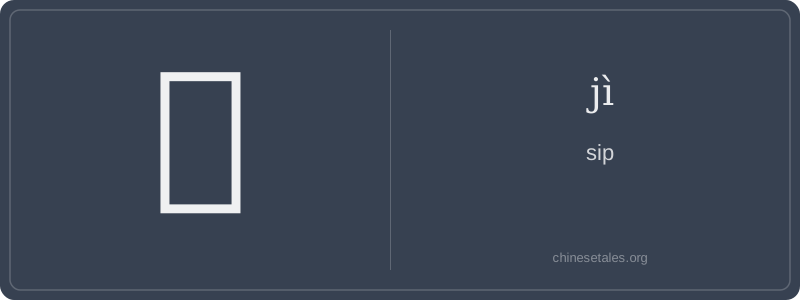
Oracle bone inscriptions show no direct precursor to 哜, but its earliest form appears on Warring States bronze vessels as a compound: 口 (mouth) + 齊 (qí, 'even, aligned') — not the modern simplified 齐, but the ancient form with three parallel strokes representing equalized grains or ritual vessels. The 口 radical was always central, anchoring the action to the mouth; the 齊 component didn’t mean 'equal' here literally, but evoked *harmony, balance, and measured intake* — like pouring wine evenly into ritual cups. Over centuries, 齊 gradually simplified, losing its top horizontal stroke and merging its verticals, until the Song-dynasty printed form crystallized into today’s 哜: nine clean strokes, with the 口 snugly cradling the stylized 齊 base.
This visual logic reflects its semantic evolution: from ritual wine-sharing ceremonies (where sipping symbolized harmony and respect) to classical poetry, where 哜 appears in lines like '哜醽醁以微吟' ('sipping clear wine while softly chanting') — a phrase from the Tang anthology Wenyuan Yinghua. The character never meant 'swallow' or 'gulp'; its essence has always been *controlled, aesthetic tasting*. Even in the Shuowen Jiezi (2nd c. CE), Xu Shen defines it as 'tasting gently', confirming its enduring association with restrained, appreciative consumption.
Think of 哜 (jì) as the quiet, deliberate cousin of 'drink' — not gulping, not chugging, but a slow, thoughtful sip, often with appreciation or restraint. It’s a verb meaning 'to sip' (especially liquids like wine or tea), and carries a refined, almost literary flavor: you’ll rarely hear it in casual chat, but it shines in poetry, classical allusions, or elegant prose where nuance matters. Its core feeling is *intentional smallness* — each sip is measured, conscious, and sensory.
Grammatically, 哜 functions as a transitive verb and usually appears in formal or descriptive contexts, often paired with elegant nouns: 哜酒 (jì jiǔ, 'sip wine'), 哜茶 (jì chá, 'sip tea'). Unlike common verbs like 喝 (hē), which is neutral and ubiquitous, 哜 requires an object and resists colloquial constructions — you wouldn’t say 'I 哜 water' without poetic license. Learners sometimes mistakenly use it like 喝 or 吸 (xī, 'to inhale'), but 哜 is exclusively oral, liquid-focused, and never used for air, smoke, or abstract concepts.
Culturally, 哜 evokes literati refinement — the image of a Tang dynasty poet sipping warm plum wine by a bamboo grove, savoring each mouthful like a ritual. Modern usage is rare outside literary imitation or branding (e.g., high-end tea shops). A common mistake is overusing it in spoken Mandarin; native speakers will likely smile and switch to 喝 or 品 (pǐn, 'to taste') instead. Also, beware tone: jì (fourth tone) is easily mispronounced as jī (first tone) — that would sound like 'chicken' (鸡), not 'sip'!