嚆
Character Story & Explanation
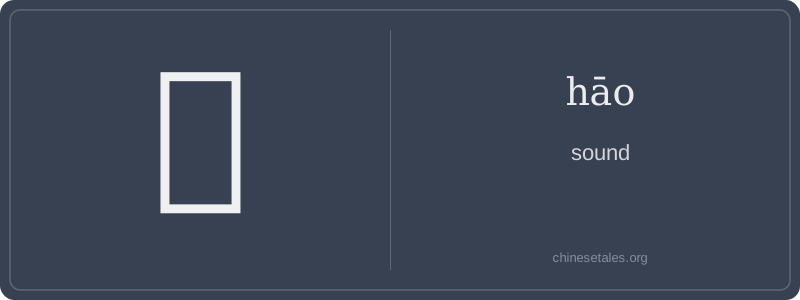
The earliest form of 嚆 appears in late Warring States bronze inscriptions as a composite glyph: a mouth radical 口 (depicting an open mouth emitting sound) fused with 高 (gāo, 'high/tall'), which originally showed a tall watchtower with a platform. Visually, it was 口 placed *above* a simplified 高 — suggesting a voice projected powerfully from elevation. Over centuries, the upper part standardized into the modern 高 shape (10 strokes), while the 口 remained crisp and centered at the top-left corner — totaling 16 strokes. The character’s layout literally shouts: 'sound from height!'
This visual logic anchored its meaning: not just sound, but a *projected*, *authoritative*, *initiating* sound — like a horn call from a watchtower announcing danger or rallying troops. By the Han dynasty, it appears in the Shuōwén Jiězì as 'the sound of the horn used to begin battle'. Later, in Du Fu’s frontier poems, hāo evokes both literal horn blasts and metaphorical 'first signs' — a semantic expansion that birthed the enduring idiom 嚆矢. Even today, the character’s towering 高 component silently reminds us: this sound doesn’t whisper — it commands the horizon.
Imagine you’re at an ancient Chinese military outpost at dawn—wind whistling through reeds, a lone scout lifts a horn and blows: hāo!—a sharp, piercing sound that cuts across the mist. That’s 嚆 in action: not just any ‘sound’, but a specific, intentional, often urgent acoustic signal—like a horn blast, whistle, or alarm cry. It’s poetic, archaic, and emotionally charged; you’ll never hear it in casual speech or modern news—it lives in classical poetry, historical novels, and rhetorical flourishes.
Grammatically, 嚆 is almost always a noun (rarely a verb) and appears in set phrases like 嚆矢 (hāo shǐ, 'the first arrow' — metaphor for the first sign or initiative) or as part of onomatopoeic compound nouns (嚆音, hāo yīn, 'initial sound'). It doesn’t take measure words like gè or zhǒng; instead, it pairs with classical modifiers: yī hāo (one sharp cry), wàn hāo (ten thousand cries — hyperbolic literary usage). Learners mistakenly treat it like generic shēngyīn (sound) or use it in spoken contexts — a red flag that instantly marks your Mandarin as textbook-archaic.
Culturally, 嚆 carries the weight of ritual precision and martial urgency. In the Zuo Zhuan, it signals troop deployment; in Tang poetry, it evokes frontier solitude. Its rarity today makes it a linguistic time capsule — mispronouncing it as hāo (not hào) or writing it without recognizing its 口 + 高 structure is a common slip. Remember: this isn’t background noise — it’s the first note of the symphony, and it demands attention.