噶
Character Story & Explanation
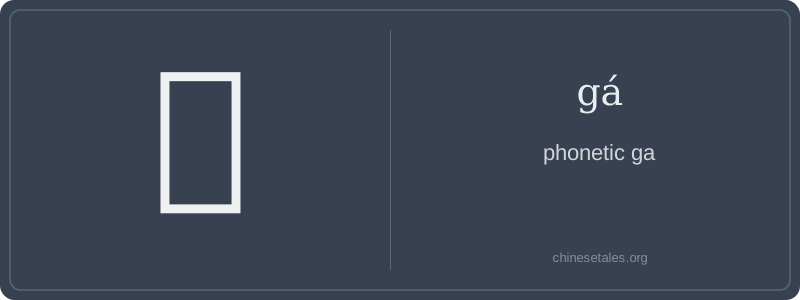
The earliest form of 噶 isn’t found in oracle bone inscriptions — it’s a relatively late invention, likely emerging during the Yuan or Ming dynasties when imperial scribes needed standardized ways to render Tibetan and Mongolian names in Chinese characters. Its structure is deliberately simple: 口 (mouth) on the left, indicating speech, and 皆 (jiē, ‘all’) on the right — but crucially, 皆 here serves *only* as a phonetic component, borrowed for its ‘gā’-like Middle Chinese pronunciation (kæi), not its meaning. Over time, the right-hand side simplified from the full 皆 (12 strokes) to its modern 15-stroke form, with the top two horizontal strokes and the ‘white’ component evolving into today’s distinctive shape — still echoing 皆’s original silhouette but stripped of semantic weight.
This character embodies a fascinating linguistic compromise: instead of inventing a new symbol, scribes repurposed existing components — 口 for domain (speech), 皆 for sound — creating a ‘phonetic loan’ character with zero semantic baggage. Unlike ancient pictographs that evolved meaning over millennia, 噶 was *designed* for one job: precision in transliteration. You won’t find it in the Shuōwén Jiězì (100 CE), nor in classical poetry — it entered dictionaries only after sustained Sino-Tibetan administrative and religious exchange made accurate name rendering essential.
噶 (gá) is a pure phonetic character — it carries no inherent meaning of its own, functioning almost like a Chinese 'sound-alike' placeholder. Think of it as the Mandarin equivalent of writing 'kha' in English to approximate a foreign or dialectal sound: it’s not a word you’d use to express ideas, but rather a tool to capture pronunciation — especially in transliterations of Tibetan, Mongolian, or other minority language names and terms. Its mouth radical 口 signals that this character is speech-related, but unlike most 口 characters (like 吃 ‘eat’ or 叫 ‘shout’), 噶 doesn’t describe an action or emotion — it just *sounds* like ‘ga’.
Grammatically, 噶 appears almost exclusively in proper nouns — personal names (e.g., 噶瑪巴 Gámǎbā, the Karmapa Lama), place names (e.g., 噶爾 Gá’ěr, a county in Tibet), or religious titles. You’ll never see it in verbs, adjectives, or common vocabulary. Learners sometimes mistakenly treat it as a standalone word or try to use it in colloquial speech — but it has zero usage outside transliteration contexts. It never appears in HSK materials precisely because it’s not part of functional, everyday Chinese.
Culturally, 噶 is a quiet testament to China’s linguistic diversity: it exists *only* because Mandarin needed a way to write non-Sinitic sounds accurately. Its presence in official documents, maps, and Buddhist texts reflects centuries of cross-linguistic contact — yet most native Mandarin speakers couldn’t define it without context. A common mistake is misreading it as 加 (jiā, ‘add’) or 卡 (kǎ, ‘card’/‘stuck’) due to visual similarity — but those are fully semantic characters with rich grammatical lives, while 噶 is purely phonetic scaffolding.