噳
Character Story & Explanation
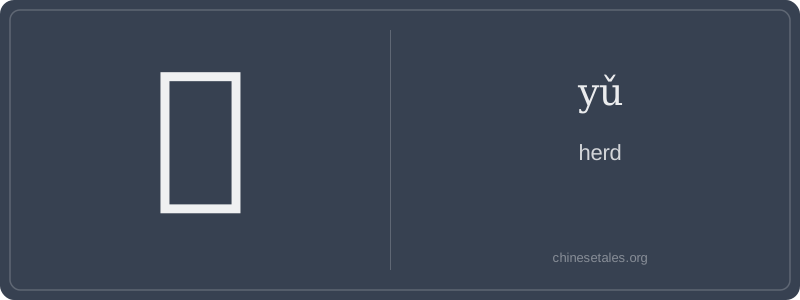
Carved onto oracle bones over 3,000 years ago, the earliest form of 噳 wasn’t a ‘herd’ at all — it was a pair of stylized mouths (口口) stacked atop a phonetic component ‘禹’ (Yǔ, a legendary flood-control hero), suggesting ‘the sound associated with Yu’s mass labor crews’. Over centuries, the two mouths fused into the top ‘呂’ (lǚ, meaning ‘spine’ or ‘paired structures’), while the lower ‘禹’ simplified and absorbed the ‘口’-like elements — giving us today’s 噳: a visual echo of synchronized vocalization, not animals. Every stroke whispers coordination: the double ‘口’ at the top? Not ‘mouths’ literally — but *repetition*, *resonance*, *unison*.
This phonosemantic evolution reveals its true essence: 噳 never meant ‘a group of animals’ as a thing — it meant ‘the act of gathering en masse *with audible cohesion*’. The Shuōwén Jiězì (121 CE) defines it as ‘zhòng yě’ (‘massing together’), citing its use in describing crowds surging through city gates or wild geese converging mid-air. In Du Fu’s poems, 噳 appears not for livestock, but for refugees ‘噳然流徙’ — their collective footsteps and murmurs forming a single, sorrowful sound. The character doesn’t depict bodies — it depicts the *acoustic signature of collective movement*.
Here’s the truth no textbook will tell you: 噳 isn’t just ‘herd’ — it’s the *sound* of a herd. That ‘yǔ’ isn’t arbitrary; it’s onomatopoeic, mimicking the low, rumbling murmur of dozens of cattle moving together across open land — a collective breath, a living hum. In classical Chinese, 噳 appears almost exclusively as a rare literary verb meaning ‘to gather in mass, to throng’, always evoking motion, density, and organic unity — never static counting. You won’t find it in ‘a herd of sheep’ (that’s 群羊), nor in modern spoken Mandarin at all. It lives only in poetic or archaic registers, like describing migrating geese 噳然南飞 (‘rumbling southward in formation’) — where the character itself *vibrates* with movement.
Grammatically, 噳 is strictly a verb — never a noun, never a classifier. Learners often mistakenly use it like 群 (qún) or 队 (duì), but that’s a critical error: saying *‘yǔ yī gè yáng’* (噳一箇羊) is nonsensical — it’s like saying ‘rumble one sheep’. Instead, it governs the *action*: ‘cattle 噳 over the hill’ (牛群噳过山岗). Its object is implied by context, not marked by particles — a subtle but vital syntactic quirk inherited from Classical Chinese verb-final structure.
Culturally, 噳 carries a quiet, almost animistic weight — it treats the group not as a sum of individuals, but as a single breathing entity with its own voice. Modern learners rarely encounter it, but when they do (in Tang poetry or Ming dynasty essays), misreading it as a noun or confusing it with homophones like 禹 or 宇 instantly breaks the rhythm and meaning. Its rarity makes it a linguistic fossil — beautiful, precise, and utterly uncompromising.