哙
Character Story & Explanation
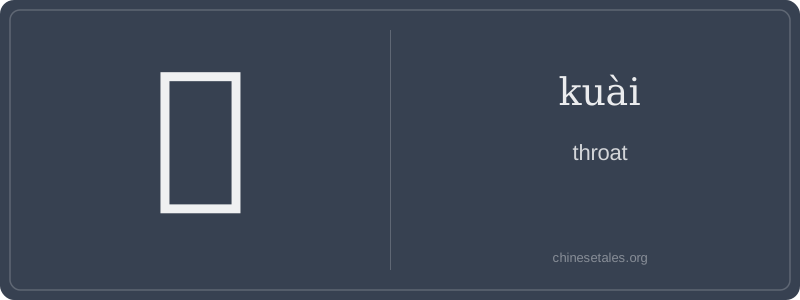
The earliest form of 哙 appears in Warring States bamboo slips as a vivid compound: left side was 口 (mouth), right side was 會 (huì, ‘to gather’ or ‘assemble’), written with simplified strokes suggesting convergence — specifically, the gathering of breath and sound *at the throat*. Over time, 會 gradually simplified into the current right-hand component, losing its full ‘assembly’ structure but keeping its phonetic role (kuài) and hint of confluence — where air, voice, and food all meet. Its nine strokes aren’t arbitrary: the three horizontal lines in the top-right evoke layered cartilage, while the mouth radical at left keeps attention firmly on the oral-pharyngeal gateway.
This convergence idea became central to its meaning: by the Han dynasty, 哙 specifically denoted the upper pharynx — not just tissue, but the functional junction where swallowing, breathing, and speaking intersect. In the Shuō Yuàn, Confucius praises a disciple who ‘spoke with a 哙然 voice’ — meaning his words emerged clearly, without obstruction, like breath released from a relaxed, open throat. That sense of unblocked resonance stuck: 哙 isn’t passive anatomy; it’s the *space* through which presence and intention pass. Its shape literally holds that idea — mouth + convergence = the throat as conduit, not container.
Think of 哙 (kuài) not as a dry anatomical term, but as the 'throat-sound' character — it’s all about the physical act of swallowing, clearing your throat, or that deep, resonant gulp you make before speaking up. The 口 (mouth) radical isn’t just decorative: it anchors the meaning in vocalized bodily action, not abstract anatomy. Unlike English ‘throat’, which is purely structural, 哙 carries an audible, almost performative quality — you don’t just *have* a 哙; you *use* it to swallow, sigh, or even express exasperation.
Grammatically, 哙 is almost never used alone in modern speech — it’s a classical fossil turned poetic flavoring. You’ll find it mainly in literary compounds like 咽哙 (yān kuài), where it echoes the motion of swallowing, or in fixed phrases such as 哙然 (kuài rán), meaning ‘with a clear, open throat’ — often describing unburdened laughter or relief. Learners sometimes misread it as ‘kuǎi’ or confuse it with 脍 (kuài, ‘minced meat’) because of identical pinyin and shared tone — but they share zero semantic ground! Pronouncing it as wèi (a rare, archaic reading in specific classical contexts) is like finding a vinyl record in a streaming playlist: possible, but practically irrelevant today.
Culturally, 哙 has a quiet dignity — it appears in the Zuo Zhuan and Shuō Yuàn describing dignified throat-clearing before delivering counsel to rulers. Modern learners rarely need it, but spotting it is like catching a whisper from ancient court ritual: a reminder that even breathing and swallowing were once choreographed acts of respect. Don’t force it into conversation — let it be your secret handshake with classical Chinese elegance.