噱
Character Story & Explanation
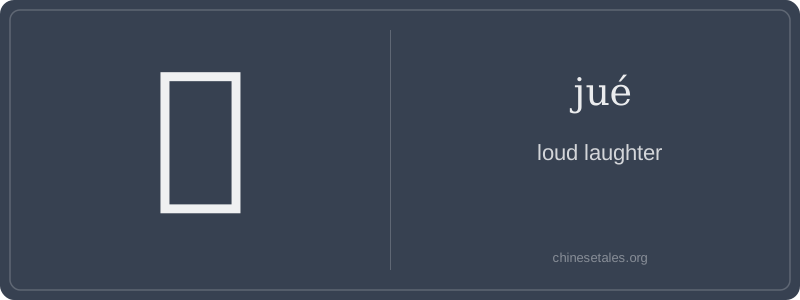
The earliest trace of 噱 appears not in oracle bones, but in late Warring States bamboo slips and Han dynasty seals—where it evolved from 口 (kǒu, 'mouth') plus 學 (xué, 'to learn'), later simplified to 孚 (fú, 'to hold/contain') plus 于 (yú, 'at/by') in clerical script. Visually, the modern form retains 口 on the left (emphasizing vocal origin), while the right side, once 學, gradually condensed into the elegant yet angular (a variant of 孚 + 于). Every stroke—from the sharp hook of the 口’s lower right corner to the upward flick of the final dot—mirrors the sudden, explosive release of air and sound.
This character wasn’t born in laughter—it was forged in performance. In Tang and Song dynasty entertainment manuals, 噱 described the deliberate, timed bursts of laughter used by storytellers (shuōhuà) to punctuate absurd twists. By the Ming-Qing era, it appeared in plays like the *Jin Ping Mei*, where characters ‘噱倒众人’ (‘brought the crowd down with a gag’). Its visual weight—16 strokes, dense and dynamic—mirrors how real laughter isn’t light or fleeting, but a full-body event demanding breath, timing, and presence.
Think of 噱 (jué) as the Chinese onomatopoeic exclamation for *uncontrollable*, belly-shaking laughter—the kind that makes you snort, gasp, or double over. It’s not just 'laugh' (笑 xiào) or 'giggle' (咯咯 gēgē); it’s the visceral, loud, almost performative burst—like a comic landing a perfect punchline. Its core feeling is theatrical, physical, and slightly exaggerated: laughter that escapes the mouth before the brain approves.
Grammatically, 噱 functions mainly as a verb in literary or stylized speech, often in reduplicated form (噓噓, though more commonly 噱噗 or in compounds), or as the head of set phrases like 噱头 (juétou, 'comic relief' or 'gag'). You won’t find it in casual chat ('I laughed' = 我笑了 wǒ xiào le), but you *will* see it in essays about comedy, theater reviews, or classical-inspired prose—e.g., '他一开口就满堂噱' (He hadn’t even finished his first sentence when the whole hall erupted in uproarious laughter). It rarely stands alone; it thrives in compounds and rhythmic repetition.
Culturally, 噱 carries echoes of traditional Chinese opera and storytelling, where vocal expressiveness was paramount. Learners often misread it as xuè (like 血) or confuse its tone—it’s fourth tone, *jué*, not second. And crucially: it’s *not* used for polite chuckles or ironic smiles. If you use it to describe your friend’s quiet giggle at a meme, native speakers will blink—and then laugh *at* you, not *with* you.