噭
Character Story & Explanation
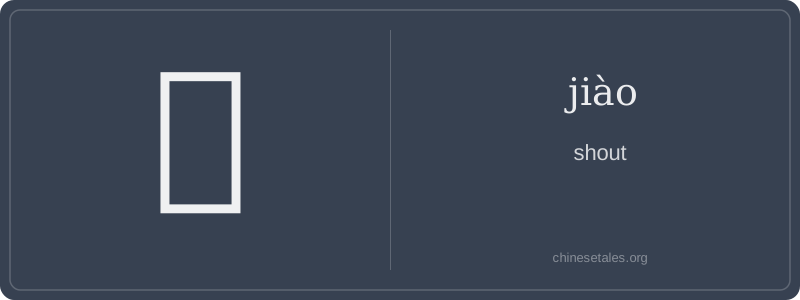
The earliest form of 噭 appears in bronze inscriptions as a combination of 口 (mouth) and 敫 — itself a compound of 白 (bright light, later simplified) and 攵 (hand holding a stick, implying action). In oracle bone script precursors, 敫 evoked a person gesturing wildly under bright light, perhaps signaling danger or rallying others. Over centuries, the white component evolved into the top dot-and-horizontal stroke (⺍), the hand became 攵, and the mouth radical stabilized on the left — yielding today’s 14-stroke structure: 口 + ⺍ + 攵. Visually, it’s a mouth launching energy outward, amplified by motion and illumination.
This vivid origin shaped its meaning: in the Classic of Poetry (Shījīng), 噭 appears in odes describing frontier guards shouting warnings across mountain passes — not casually, but as life-saving acts of sonic projection. By the Tang dynasty, poets like Du Fu used it for cries piercing silence: ‘风急天高猿啸哀,渚清沙白鸟噭愁’ — where 鸟噭愁 (birds shriek with sorrow) conveys piercing, emotionally charged sound. Even today, its shape whispers ‘voice + light + motion’, making it one of Chinese writing’s most graphically literal depictions of shouting.
At its core, 噭 (jiào) isn’t just ‘shout’ — it’s a *resonant, full-throated cry*, often with urgency, alarm, or raw emotion. Think less 'yell at your roommate' and more 'a shepherd bellowing across a canyon to warn of wolves' — it carries weight, distance, and visceral immediacy. Unlike the neutral 叫 (jiào), which covers everything from 'to be called' to 'ordering food', 噭 is literary, emphatic, and rare in speech; you’ll almost never hear it in daily conversation, but you’ll see it in classical poetry, historical novels, or dramatic stage directions.
Grammatically, it functions as a verb — always transitive or intransitive action, never passive or stative. It doesn’t take aspect particles like 了 or 过 easily (‘*噭了’ sounds archaic or jarringly poetic), and it rarely appears in modern compound verbs. You’ll find it in subject-verb-object constructions like ‘他噭道’ (He shouted out), where 噭 stands alone, unadorned, like a drumbeat. Its rarity means learners who insert it into casual speech risk sounding like a Ming-dynasty opera character — charming, but utterly out of place.
Culturally, 噭 reflects how Chinese writing preserves vocal intensity through visual density: notice how the mouth radical (口) anchors the character, while the right side (敫) — originally depicting a torch-lit figure raising arms — adds dynamism and projection. Learners often misread it as 叫 or even 嚣 (xiāo, 'clamor'), missing its specific connotation of *directed, forceful vocal emission*. The biggest trap? Assuming it’s interchangeable with 叫 — it’s not. Using 噭 instead of 叫 in spoken Mandarin is like using ‘hath’ instead of ‘has’ in English: grammatically sound, historically grounded, and socially awkward.