噬
Character Story & Explanation
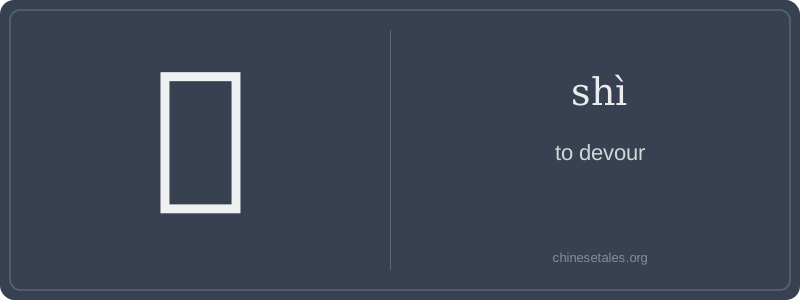
The earliest form of 噬 appears in late Shang oracle bone inscriptions as a vivid pictograph: a mouth (口) biting down on a stylized, writhing creature — sometimes interpreted as a worm or serpent — with a clear vertical stroke representing the act of biting *through*. Over centuries, the ‘creature’ evolved into the right-hand component 舐 (shì), which itself originally meant ‘to lick’ but was repurposed phonetically and graphically. By the Qin seal script, the mouth radical anchored the left side, while the right side stabilized into today’s 舐 — a complex 11-stroke unit combining 舌 (tongue) and 典 (classic, here acting phonetically). The full character thus visually enacts its meaning: mouth + biting action = devour.
This evolution mirrors a semantic deepening: from literal biting (early bronze inscriptions) to voracious consumption (Warring States texts), then to abstract, metaphorical devouring by intangible forces — time, emotion, ideology. Confucius’s Analects doesn’t use 噬, but by the Han dynasty, it appears in philosophical treatises describing how unchecked desires ‘devour virtue’. Its visual drama — a mouth aggressively engaged — made it ideal for expressing irreversible, consuming processes, cementing its role as the go-to character for existential or poetic consumption, never mundane ingestion.
At its core, 噬 (shì) isn’t just ‘to eat’ — it’s to *devour*, to *consume utterly*, often with violence, inevitability, or ominous finality. Think less ‘snack’ and more ‘the jungle swallows the unwary traveler’. It carries visceral weight: the bite is deep, the consumption total, the implication often metaphorical — time devours youth, greed devours integrity, silence devours truth. You’ll rarely hear it in daily chatter about lunch; it belongs to literature, philosophy, and dramatic rhetoric.
Grammatically, 噬 is a transitive verb that almost always takes a direct object (e.g., 噬人 ‘devours people’, 噬心 ‘devours the heart’), and it frequently appears in literary or fixed expressions rather than casual speech. It’s never used alone as an imperative — you wouldn’t say ‘Shì!’ like ‘Eat!’. Instead, it thrives in compound verbs (like 吞噬) or as the head of vivid metaphors. Learners mistakenly use it where 吃 or 进食 would suffice — a classic ‘over-literary’ error that makes your sentence sound like a classical tragedy.
Culturally, 噬 reflects a deep-rooted Chinese sensitivity to *inescapable forces*: fate, decay, desire, or systemic pressure — all imagined as active, ravenous agents. In the Yi Jing (Book of Changes), Hexagram 21 (Shì Kè) literally means ‘Biting Through’, symbolizing the necessity of decisive, even harsh, action to overcome obstruction — like teeth breaking through something tough. That ancient resonance still echoes: when a modern writer says ‘焦虑噬心’, they’re not just describing worry — they’re invoking an ancient image of inner corrosion.