噫
Character Story & Explanation
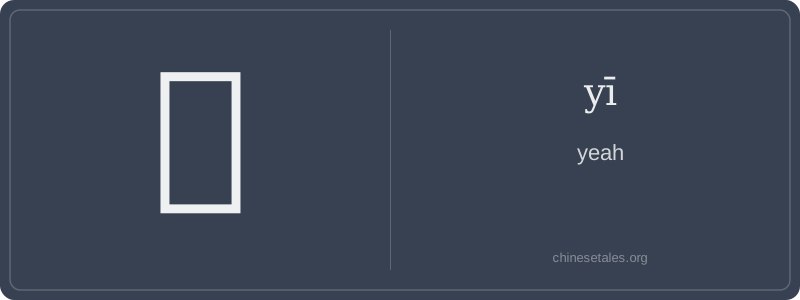
The earliest form of 噫 appears in bronze inscriptions as a combination of 口 (kǒu, 'mouth') and 伊 (yī, a phonetic loan character originally depicting a person beside a banner). In oracle bone script, though not directly attested for 噫, its phonetic component 伊 likely derived from a pictograph of a standing figure with a ceremonial standard — evoking proclamation, declaration, or emphatic speech. Over time, the left side solidified into 口, emphasizing vocalization, while the right evolved from 伊’s ancient form (亻+尹) into today’s simplified structure: 口 + 一 + 豕 (though visually it now reads as 口 + + 一 + 丿 + 丶 + 丶 + 丿 + 丶 — sixteen strokes total, mirroring the breathy, drawn-out quality of the exhalation it represents).
Its meaning crystallized early: in the Shuō Wén Jiě Zì (121 CE), Xu Shen defined 噫 as 'a sound of sorrow or lamentation', linking it to deep-breath exhalations expressing grief or awe. By the Tang dynasty, poets like Li Bai used it to punctuate existential wonder ('噫!吾知之矣' — 'Ah! Now I understand!'). The character never became grammaticalized into a functional particle — it remained proudly, stubbornly interjective, resisting simplification and everyday erosion, surviving precisely because it refuses to be ordinary.
Think of 噫 not as a polite 'yes' but as the verbal equivalent of raising both eyebrows and letting out a breathy, slightly theatrical 'Yeeeah—?' — it’s an interjection dripping with skepticism, irony, or sudden realization. It’s not a standalone affirmation like 是 (shì) or 对 (duì); it’s emotional punctuation, almost always appearing at the start of a sentence or clause, followed by a pause or a contrasting clause. You’ll rarely hear it in casual conversation today, but you’ll see it everywhere in classical poetry, modern satire, and internet memes mimicking old-style sarcasm.
Grammatically, 噫 functions like a discourse particle: it sets tone before a statement or rhetorical question. For example, 噫!这怎么可能? (Yī! Zhè zěnme kěnéng?) isn’t just 'Yeah, how is this possible?' — it’s more like 'Oh *come on* — how is this even possible?!' Learners often mistakenly use it like English 'yeah' mid-conversation ('Yeah, I agree'), which sounds jarringly archaic or comically pretentious. It doesn’t take objects, verbs, or complements — it stands alone, then yields the floor.
Culturally, 噫 carries literary weight — it’s the sigh of Qu Yuan lamenting corruption in Li Sao, the gasp of a Tang poet confronting mortality. Modern speakers deploy it deliberately for ironic detachment, like typing '噫...' in a WeChat group after someone shares outrageously bad news. Mistake it for a neutral filler word, and you’ll accidentally sound like a Ming-dynasty scholar judging your friend’s life choices.