噩
Character Story & Explanation
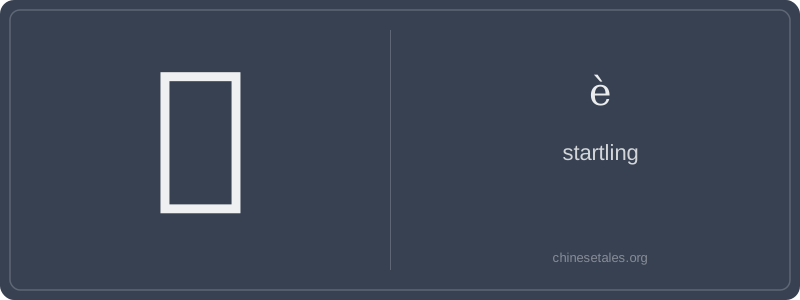
The earliest form of 噩 appears in bronze inscriptions as four identical ‘mouths’ (口) stacked vertically — 口口口口 — symbolizing repeated, overlapping cries of alarm. This wasn’t literal shouting, but a visual metaphor for overwhelming, inescapable distress: imagine four witnesses screaming at once, their voices colliding into a single wave of panic. Over centuries, the top two mouths simplified into two ‘W’-like shapes (亜), while the bottom two remained as 口 — and the central ‘square’ (王) emerged as a stabilizing frame, turning chaos into structure. By the Han dynasty, the modern 16-stroke form crystallized: four mouths bound by symmetry and stroke order discipline — a paradox: controlled representation of uncontrolled terror.
This evolution mirrors its semantic journey. In early texts like the *Zuo Zhuan*, 噩 described omens so dire they demanded ritual purification — eclipses, floods, or unnatural animal behavior. By the Tang, it narrowed to human-scale catastrophes: the death of a sovereign, betrayal by a trusted minister. Its presence in poetry (e.g., Li Bai’s lines on ‘噩风卷地’ — ‘the nightmare wind sweeping the land’) cemented its association with forces beyond human control. Crucially, the four mouths aren’t random — they echo the ancient belief that grave misfortune must be announced *four times* to pierce heaven’s silence, making 噩 less a word than a ritual incantation frozen in ink.
Think of 噩 (è) as Chinese’s version of a jump-scare — not the kind in horror movies, but the linguistic equivalent of slamming a book shut mid-sentence: sudden, visceral, and deeply unsettling. It doesn’t mean ‘scary’ in a general sense (that’s 怕 or 恐怖), nor does it describe something eerie or suspenseful (like 阴森). No — 噩 is reserved for the *moment* reality cracks open: a phone call with terrible news, a headline that stops your breath, the split second before you realize the diagnosis is terminal. It’s an adjective that clings to nouns like ‘dream’, ‘news’, or ‘event’ — always paired, never standalone.
Grammatically, 噩 almost never stands alone. You’ll nearly always see it in compounds: 噩梦 (è mèng, nightmare), 噩耗 (è hào, devastating news), or 噩运 (è yùn, ill fate). It rarely modifies verbs directly — you wouldn’t say ‘I 噩ed’ — and never appears in casual speech or beginner texts. Learners often misapply it like English ‘awful’ or ‘terrible’, but that’s like calling a rainy picnic ‘apocalyptic’. The nuance is sharper: it implies shock + gravity + irreversible consequence.
Culturally, 噩 carries ancestral weight — it’s a literary, almost classical character, still used in formal obituaries, news bulletins, and historical novels, but conspicuously absent from social media slang or pop lyrics. A common mistake? Confusing it with 恶 (ě/wù/è), which means ‘evil’ or ‘to hate’ — same pinyin tone in one reading, but wildly different semantic terrain. Using 噩 instead of 恶 (or vice versa) doesn’t just sound odd; it swaps moral judgment for existential shock.