哕
Character Story & Explanation
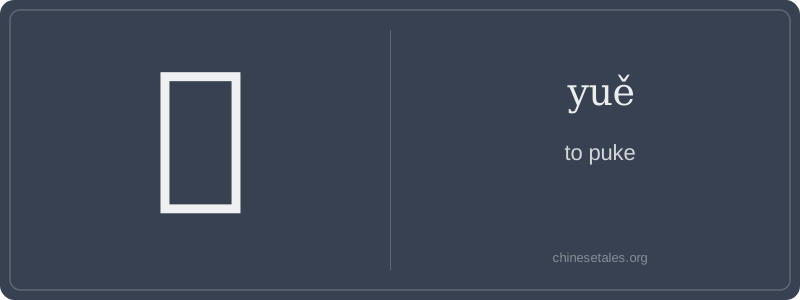
The earliest form of 哕 appears in bronze inscriptions as a combination of 口 (mouth) and 贝 (bèi, shell — here likely phonetic, not monetary). Over time, 贝 simplified into 夂 (zhǐ), a stroke sequence mimicking downward movement — think of a hand pushing something *out* of the mouth. By the Han dynasty, the shape stabilized: 口 on the left (emphasizing oral origin), and 夂 on the right, its three strokes evoking the jerking motion of retching — one stroke for the lift, one for the thrust, one for the release.
This visual logic became semantic truth: in the Huangdi Neijing (Yellow Emperor’s Classic of Internal Medicine), 哕 is used specifically for 'hiccough-like vomiting' — not just expulsion, but *rhythmic*, involuntary upward surging from the stomach. Later, poets like Du Fu employed 哕 to evoke physical distress amid moral anguish ('风急天高猿啸哀,渚清沙白鸟飞回。无边落木萧萧下,不尽长江滚滚来。万里悲秋常作客,百年多病独登台。艰难苦恨繁霜鬓,潦倒新停浊酒杯。' — though not using 哕 directly, his style mirrors its visceral precision). Its shape *is* its meaning: mouth + motion = the body interrupting speech with sound.
Think of 哕 (yuě) as Chinese onomatopoeia with attitude: it’s not just 'to puke' — it’s the sharp, visceral *sound* and *sensation* of sudden, forceful vomiting. Unlike clinical terms like 呕吐 (ǒu tù), 哕 carries literary weight and bodily immediacy — you hear the gag, feel the heave. It’s rare in casual speech but appears in classical texts, medical descriptions, and expressive writing where physical authenticity matters.
Grammatically, 哕 functions mainly as a verb, often in reduplicated form 哕哕 (yuě yuě) to emphasize repeated retching, or as a standalone verb in formal or literary contexts (e.g., '他突然哕了一声'). It doesn’t take aspect particles like 了 or 过 as readily as everyday verbs — adding them feels stilted. Learners sometimes wrongly treat it like a colloquial slang word; in reality, it’s more poetic than profane — you’d find it in a Tang dynasty poem describing seasickness, not in a WeChat message about last night’s dumplings.
Culturally, 哕 hints at how Chinese traditionally links sound, body, and diagnosis: ancient physicians noted specific vomit sounds (like 哕 vs. 呕 vs. 吐) to infer organ imbalances. A common mistake? Confusing it with 易 (yì) or 哥 (gē) — its small size and unusual tone (yuě, with that dipping-rising 'ě') trip up even advanced learners. Remember: this character doesn’t whisper — it *gags*.