哝
Character Story & Explanation
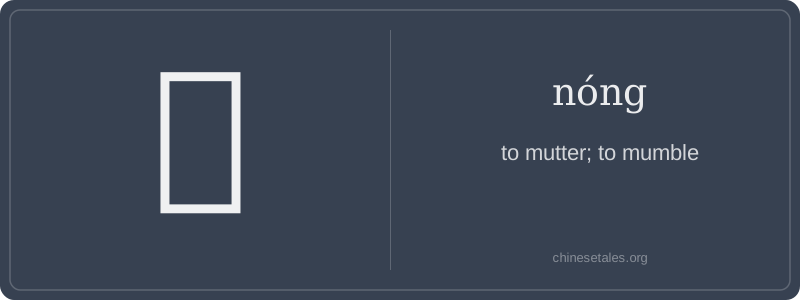
The earliest trace of 哝 appears not in oracle bones, but in late Warring States bamboo slips — a deliberate fusion character. Its left side 口 is classic: a stylized mouth, unchanged for 2,500 years. The right side 弄 began as two hands (廾) manipulating a jade tablet (王) — symbolizing careful handling. By the Han dynasty, 弄 simplified, and scribes combined it with 口 to create 哝: literally 'mouth-handling' — speech so tentative it must be physically managed, not freely emitted. Stroke order reflects this: first the mouth frame (3 strokes), then the 'handling' gesture — five strokes forming 弄’s core (一 丿 ㇏ 丨), totaling nine.
This 'mouth-handling' concept crystallized in Tang poetry, where 哝哝 first appeared to capture the hushed, repetitive utterances of sleepers or grieving widows — not as lament, but as involuntary vocal tics of deep feeling. Du Fu never used it, but Bai Juyi did, describing a grandmother ‘nóng nóng’ counting rosary beads while praying — speech reduced to rhythm, not meaning. That duality — physical mouth + fumbling hands — remains embedded in every modern usage: the sound isn’t failing; it’s being *tended*, like a fragile ember.
哝 (nóng) is the sound of words dissolving into themselves — think low-volume, half-formed syllables escaping lips without full intention. It’s not shouting, not whispering, but that muffled, rhythmic murmur you hear when someone’s reading aloud to themselves, arguing silently with a bus schedule, or muttering under their breath after stubbing a toe. The character’s mouth radical 口 immediately tells you this is vocal, physical speech — not abstract thought — and the right-hand component 弄 (nòng, 'to handle, fiddle with') hints at speech being *manipulated*, not fully released: words handled clumsily, twisted, or half-controlled.
Grammatically, 哝 is almost always used as a verb in reduplicated form 哝哝 (nóng nóng) — never alone — and typically appears in descriptive clauses or as an onomatopoeic complement. You’ll see it after verbs like 说 (shuō, 'to speak'), 低 (dī, 'low'), or 自言自语 (zì yán zì yǔ, 'to talk to oneself'): 他低声哝哝着||He muttered quietly under his breath. Crucially, it’s *not* used for clear speech, singing, or formal recitation — that’s where learners often slip, confusing it with 朗读 (lǎngdú, 'to read aloud').
Culturally, 哝 carries gentle intimacy or mild exasperation — never menace. In literature, it evokes private inner worlds: a child murmuring bedtime wishes, an elder reminiscing softly. Non-native speakers sometimes overuse it trying to sound poetic, but native speakers reserve it for moments where sound blurs into thought. Also, don’t confuse it with 哼 (hēng) — which expresses disdain or indifference — or with 喃 (nán), which is more literary and often paired with 喃喃 (nán nán). 哝 feels warmer, earthier, more bodily.