噤
Character Story & Explanation
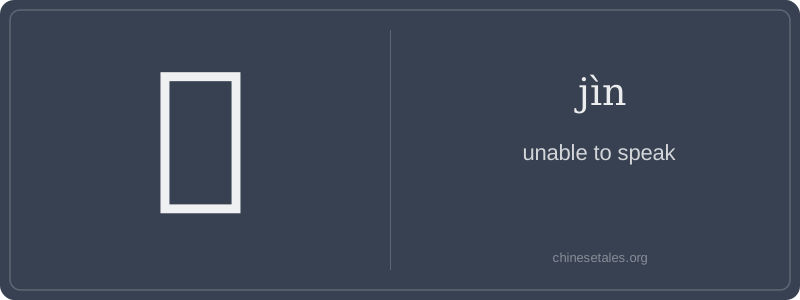
The earliest form of 噤 appears in bronze inscriptions as a combination of 口 (mouth) and 禁 (jìn, ‘forbid’) — not as separate characters, but as a unified glyph where the mouth radical is embedded within a stylized version of 禁’s upper component (林, representing dense woods or barriers) and lower component (示, altar symbolizing authority). Over centuries, the top evolved into 金 (metal, suggesting rigidity), while the mouth radical stayed prominent at the left — visually embodying ‘a mouth locked down by unyielding authority’. By the Han dynasty, the structure stabilized into today’s 16-stroke form: 口 + 金 + 支, with 支 (zhī, ‘to support/prop up’) subtly suggesting the act of *holding back* speech like bracing a door.
This visual logic shaped its meaning: not mere quiet, but *enforced muteness*. In the Zuo Zhuan, officials are described as ‘噤不敢言’ when confronting tyrannical rulers — their mouths literally ‘shut by prohibition’. Later, in Tang poetry, 噤 appears in nature metaphors: ‘风噤林梢’ (the wind holds its breath at the treetops), anthropomorphizing silence as an active, reverent pause. The character’s power lies in this duality: it looks like a mouth under metal constraint, yet it conveys something deeply human — the moment language fails us.
Imagine you’re at a tense family dinner: your uncle just dropped a political bombshell, your aunt freezes mid-bite, and the whole table falls into a thick, heavy silence — not relaxed quiet, but the kind where your throat tightens and words physically won’t come out. That’s 噤 (jìn): not just ‘silent’, but *paralyzed speech* — a visceral, involuntary suppression of voice, often from fear, shock, or awe. It’s poetic, literary, and emotionally charged — you’d never say ‘请噤声’ in a library; you’d use 请安静. 噤 lives in novels, speeches, and solemn moments.
Grammatically, 噤 is almost always used as a verb in compound structures like 噤若寒蝉 (jìn ruò hán chán) or as part of the phrase 噤声 (jìn shēng, ‘to fall silent’). It rarely stands alone — you won’t see ‘他噤’; instead, it appears in phrases like ‘吓得噤了声’ (scared into silence) or ‘全场为之噤然’ (the entire hall fell silent). Note: it’s not an adjective — don’t say ‘噤的气氛’; that’s ungrammatical. Learners often mistakenly treat it like 静 or 默, but 噤 carries active, physiological weight — it’s about *being unable*, not choosing to be quiet.
Culturally, 噤 evokes classical restraint and moral gravity — think of Confucian warnings against reckless speech or the chilling silence before imperial punishment. Modern usage leans literary or rhetorical: politicians use it in speeches to dramatize collective awe or fear. A common pitfall? Overusing it in casual writing — it sounds archaic or overly dramatic in WeChat chats. Reserve it for when silence feels like a physical force gripping the throat.