噢
Character Story & Explanation
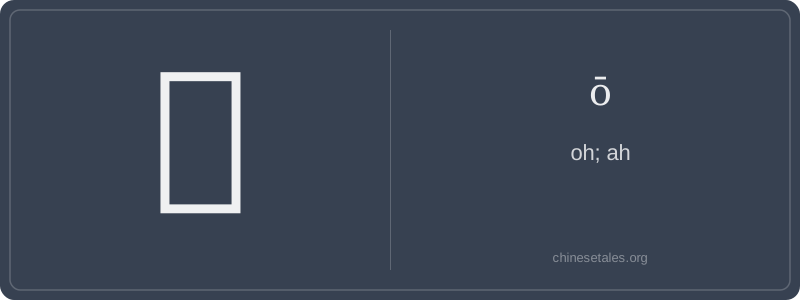
The earliest trace of 噢 isn’t ancient at all — it’s a late Qing dynasty innovation, born not from oracle bones but from the need to transcribe Western interjections in missionary texts and translated novels. Its structure is brilliantly pragmatic: the radical 口 (kǒu, ‘mouth’) anchors it as a vocal expression, while the phonetic component 奥 (ào, ‘profound, deep’) was borrowed purely for its sound — the ‘o’ vowel resonance. Visually, the 15 strokes assemble like a mouth (口) opening wide, then narrowing into the intricate, layered strokes of 奥 — evoking the shape of lips rounding and releasing a low, contemplative hum.
This character didn’t exist in classical Chinese — Confucius never said 噢. It emerged alongside modern vernacular fiction in the early 20th century, appearing in Lu Xun’s dialogues to capture the hesitant, world-weary ‘oh’ of urban intellectuals. Its visual weight — 15 strokes for a single syllable — reflects how much cultural nuance it carries: every stroke adds subtext. The ‘deep’ (奥) part isn’t semantic, but its presence makes 噢 feel heavier, more reflective than the lighter, simpler 啊 or 呀 — as if the ‘oh’ isn’t just heard, but *pondered* before leaving the mouth.
Think of 噢 (ō) as Chinese’s equivalent of the raised eyebrow + soft exhale you make when someone says something mildly surprising, gently disappointing, or quietly dawning on you — like a jazz musician humming 'ohhh' mid-solo: not a shout, not a question, but a vocal punctuation mark soaked in attitude. It’s rarely about raw information; it’s about *stance*. Unlike English ‘oh’, which can be neutral or even enthusiastic (‘Oh! A puppy!’), 噢 almost always carries subtle emotional shading: mild skepticism (‘Oh… so *that’s* why you were late’), quiet resignation (‘Oh… fine, I’ll do it’), or polite but distant acknowledgment (‘Oh… yes, I see’).
Grammatically, 噢 is an interjection — it stands alone, often at the start of speech, and never takes modifiers, objects, or particles. You’ll never see 噢了, 噢吗, or 噢吧. It’s a frozen moment of sound — like hitting pause on a thought. Learners sometimes try to use it like 啊 (a) or 呀 (ya) for emotional emphasis mid-sentence, but that’s wrong: 噢 belongs only at sentence boundaries, usually followed by a pause or a new clause. Say ‘Wǒ míngbái le… ō.’ (I understand… oh.) — the pause matters.
Culturally, 噢 is a masterclass in Chinese indirectness. A flat, drawn-out ‘Ō…’ can signal polite disengagement — the speaker isn’t arguing, but they’re certainly not agreeing. In service interactions, hearing 噢 instead of 好 (hǎo) or 是 (shì) often means your request won’t be prioritized. And crucially: never write it in formal writing — it’s strictly spoken, emotive, and conversational. Mistake it for a written particle? You’ll sound like a robot trying to fake human sighs.