哒
Character Story & Explanation
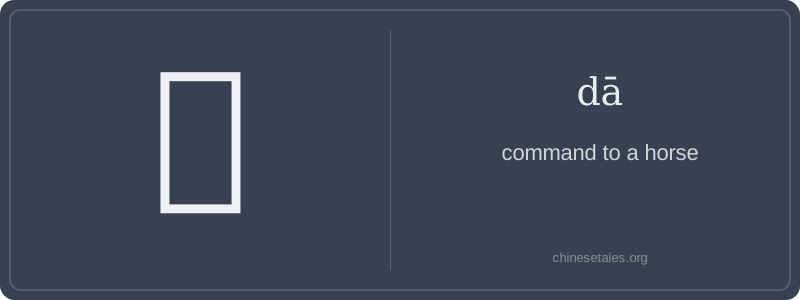
The earliest trace of 哒 isn’t in oracle bones—it’s a latecomer, born from phonetic borrowing. Its form fuses 口 (kǒu, ‘mouth’) on the left—signaling speech or sound—with 答 (dá, ‘to answer’) on the right, simplified over centuries: the original 答 had 竹 (bamboo) on top and 合 (to close) below, but by the Song dynasty, scribes began abbreviating its lower part into the modern ‘dá-like’ shape we see today. The nine strokes emerged cleanly: three for 口, six for the streamlined right side—each stroke echoing the crispness of the sound itself.
This character didn’t exist in classical texts—it first appeared in Ming-Qing vernacular fiction and opera prompt books, where authors needed a way to *write down* the exact horse-command sound. Unlike ancient pictographs, 哒 is a deliberate onomatopoeic coinage: the mouth radical declares ‘this is spoken’, while the right side hints at its pronunciation and rhythmic force—like a verbal ‘answer’ to the rider’s will. Its evolution mirrors China’s shift from literary elegance to lively, embodied storytelling.
Imagine you’re on a dusty northern plain in old China, gripping the reins of a sturdy Mongolian horse. Your lips part—and out bursts a sharp, percussive dā!—a single-syllable command that cuts through wind and hoofbeats. That’s 哒: not a word you’d write in an essay or recite in a poem, but a visceral, mouth-shaped *sound effect*—a vocal spur used to urge horses forward. It’s not formal vocabulary; it’s oral folklore in action, alive only when spoken aloud with tongue-tap precision.
Grammatically, 哒 is almost never used alone in writing—it appears mainly in dialogue tags (especially in novels or folk storytelling) to render the actual *sound* of the command: ‘驾!’ (jià!) is the standard written imperative, but ‘哒!’ captures the guttural, staccato snap—the ‘tongue-click + stop’ sensation. Learners often misread it as a particle like 呀 (yā) or 啊 (a), but 哒 carries zero grammatical function—it’s pure phonetic mimesis. You’ll see it in quotes, rarely outside them, and almost never in formal registers.
Culturally, 哒 is a sonic fossil—a relic of equestrian life in pre-modern China, preserved in regional opera scripts, wuxia novels, and dialect storytelling. Its rarity in modern speech makes it charmingly archaic, like hearing a blacksmith’s hammer ring in a smartphone ad. A common mistake? Using it as a sentence-final particle (e.g., *nǐ hǎo dā*), which sounds absurd—like ending English greetings with ‘Neigh!’