噞
Character Story & Explanation
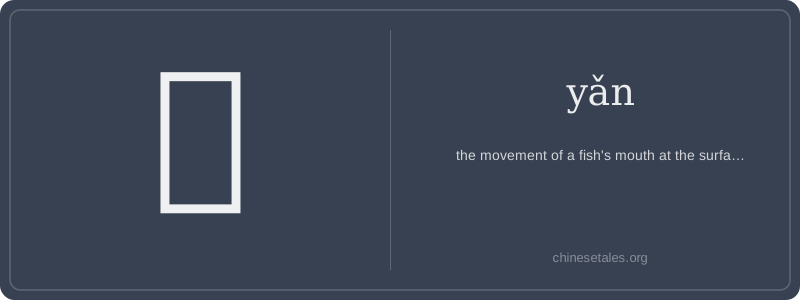
The earliest form of 噞 appears in late Warring States bamboo texts — not oracle bones, but elegant ink brushwork on slender slips. Visually, it’s a masterclass in economy: the left side 口 (mouth) is unmistakable, while the right side was originally a simplified depiction of a fish’s head with gills and an open mouth — later stylized into the modern 佥 (qiān), which once carried phonetic and semantic resonance with ‘to gather’ or ‘to emerge’. Over centuries, the fish-head morphed into a more abstract, angular shape, but the core idea — mouth + aquatic emergence — held firm.
By the Han dynasty, 噞 had crystallized into its current form and meaning, appearing in the Shuōwén Jiězì dictionary as ‘the mouth movement of fish at the water’s surface’. It’s famously used in Li Bai’s uncollected fishpond fragment: ‘池鱼噞白日,藻影漾清涟’ (‘The pond fish 噞 in the white sun; algae shadows ripple clear waves’). The character’s visual duality — mouth (口) + phonetic/semantic ‘emergence’ (佥) — mirrors its meaning: a mouth rising *out* of water, not just opening. Even today, calligraphers pause before writing 噞 — its balance feels like watching a koi rise.
Think of 噞 (yǎn) as Chinese poetry’s version of a fish ‘gasp’ — not a gasp of panic, but the quiet, rhythmic, surface-level flutter of a carp’s mouth breaking water. It’s not about breathing (fish don’t breathe air), but about that delicate, almost meditative motion: lips parting and closing just above the ripple-line. In English, we’d say ‘a fish surfaces’ or ‘a fish mouths the air’ — but in classical and literary Chinese, 噞 captures *only* that precise, fleeting lip-movement, like a haiku syllable for aquatic respiration.
Grammatically, 噞 is almost always a verb — but a highly stylized one. You won’t hear it in daily speech; it appears mainly in poetic lines, classical allusions, or descriptive nature writing. It never takes aspect particles like 了 or 过 — its power lies in its bare, present-tense immediacy. Try using it like an English gerund: ‘the fish 噞-ing at dawn’. And no, you can’t say ‘I 噞’ — it’s strictly non-human, non-idiomatic, and never used transitively. Learners often mistakenly treat it like a general ‘open mouth’ verb (like 张嘴), which completely misses its aquatic specificity and lyrical weight.
Culturally, 噞 carries the hush of Daoist observation — noticing the smallest, most transient natural gesture as a sign of life’s subtle rhythm. It appears in Tang dynasty fishpond poems and Ming-era garden inscriptions, where every ripple matters. Mistake it for a common word, and you’ll sound like someone quoting Confucius at a sushi bar: technically correct, contextually jarring. Its rarity is its charm — it’s a linguistic pearl, not a workhorse.