咝
Character Story & Explanation
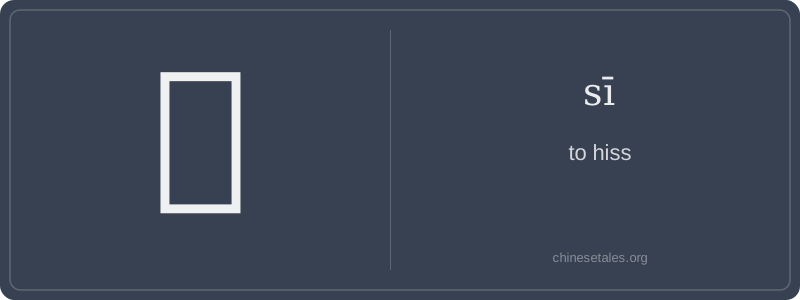
The earliest precursor of 咝 appears not in oracle bones but in late Warring States bamboo slips, where it emerges as a phonosemantic compound: 口 (kǒu, 'mouth') as the semantic radical, paired with 丝 (sī, 'silk') as the phonetic component — chosen for its identical pronunciation and its visual suggestion of fine, continuous threads. The modern form crystallized during the Han dynasty: the left 口 retains its shape, while the right evolved from 丝’s intricate double 'silk' glyph into a streamlined, triple-slash simplification (⺄ + two short diagonal strokes), evoking both the whispering friction of silk strands and the sharp, sibilant airflow of a hiss.
This visual economy was intentional: ancient scribes knew that repeated thin strokes could mimic the staccato, breathy quality of sibilants. By the Tang dynasty, 咝 appears in poetry and anecdotal texts not as a standalone word but embedded in phrases like '咝然有声' ('a sudden sss-sound arose'), signaling surprise or tension. Its meaning never strayed far from acoustic fidelity — unlike many characters that broadened semantically, 咝 stayed stubbornly sonic, anchoring language to the physical act of sound-making, a quiet testament to China’s long tradition of listening deeply before writing.
At its heart, 咝 isn’t just a dictionary definition — it’s the *sound itself made visible*. Chinese onomatopoeic characters like this one don’t merely describe hissing; they *perform* it. The moment you see those three parallel strokes (the 'sī sī sī' visual rhythm), your mouth instinctively tenses — tongue near teeth, air forced through a narrow channel. That’s not coincidence: Chinese writing often privileges auditory immediacy over abstract labeling. Native speakers don’t ‘think’ of a snake and then recall the word — they hear the sound first, and 咝 is the graphic echo.
Grammatically, 咝 is almost always used as a verb in reduplicated form (咝咝) or as an adverbial modifier (咝地一声). You’ll rarely see it alone — it thrives in vivid, sensory-driven contexts: stories, children’s books, or dramatic narration. For example: '蛇咝咝地爬过草丛' (The snake slithers *sss-sss* through the grass). Note the reduplication and the 'de' particle — omitting either makes the sentence feel unnatural or overly literary. Learners often mistakenly treat it like a regular verb (e.g., *wǒ sī* — 'I hiss'), but native usage treats it more like English ‘hiss’ — a sound-event, not an action performed by a subject with agency.
Culturally, 咝 reveals how Chinese values precision in sensory representation: the character doesn’t ask *what* is hissing, but *how exactly* it sounds — down to pitch, duration, and texture. It’s absent from formal documents and HSK lists precisely because it lives in the realm of oral storytelling and embodied language. A common learner trap? Overusing it in writing — while perfectly natural in dialogue or narrative, it feels jarringly colloquial in academic or bureaucratic contexts.