噙
Character Story & Explanation
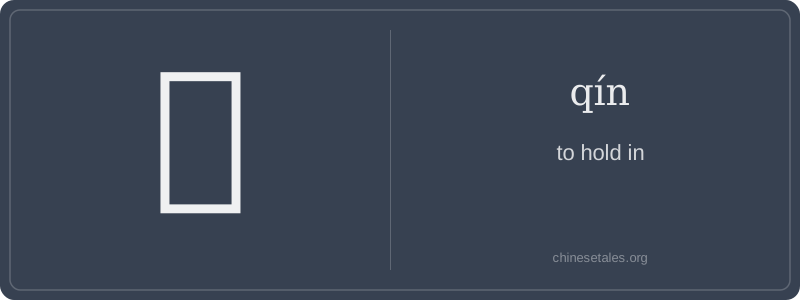
Oracle bone inscriptions show no direct precursor, but bronze script reveals an early form: a mouth 口 cradling a simplified bird-like shape — likely representing something small and animate being *held captive*. Over centuries, the bird component evolved into 禽, which originally meant 'to seize birds' (as in hunting), then generalized to 'to capture'. The 15 strokes solidified during the Han dynasty: three horizontal strokes for the mouth’s upper lip, then the full 禽 — with its distinctive 'lid' (人) over 'today' (日) and 'hand' (厶) — visually evoking something sealed tightly inside.
By the Tang dynasty, 噙 appears in poems like Du Fu’s subtle lines describing elders ‘holding back sobs’ — shifting from literal bird-holding to metaphorical emotional containment. The character’s visual tension — mouth open yet closed around something — mirrors its semantic duality: it’s both physical (a stone between teeth) and psychological (words unsaid). In Ming fiction, it’s used for defiant silence: heroes ‘hold their tongues’ (噙住舌头) rather than beg. Even today, the image remains visceral — not swallowing, not spitting, but *sustaining*.
At its heart, 噙 (qín) is a vivid, almost physical verb — not just 'to hold' but to *hold in your mouth*, like a pebble, a tear, or unspoken words. It’s intensely bodily: the mouth radical 口 anchors it firmly in oral action, while the right side 禽 (qín, meaning 'bird' or 'to seize') adds a sense of grasping and containment. This isn’t passive holding — it’s deliberate, tense, often emotional restraint.
Grammatically, 噙 is transitive and nearly always followed by what’s being held: 噙着泪 (qín zhe lèi, 'holding back tears'), 噙着话 (qín zhe huà, 'holding back words'). Note the essential aspect marker 着 (zhe) — learners often omit it, saying *噙泪* alone, but that sounds archaic or poetic; modern usage almost always uses 噙着 + noun. Also, it’s rarely used for food (we say 含 hán for 'to hold food in mouth'); 噙 implies emotional weight or suppression.
Culturally, 噙 carries literary gravity — you’ll find it in classical poetry and modern novels to evoke stifled grief, pride, or dignity. Learners mistakenly use it for everyday actions like 'holding a pen' or 'keeping keys'; it’s reserved for moments where the mouth becomes a vessel for feeling. Its rarity outside literature also means mispronunciation (e.g., confusing qín with qīn or qǐn) is common — but remember: this is the *quiet clench* of lips, not a kiss or a chin.