噘
Character Story & Explanation
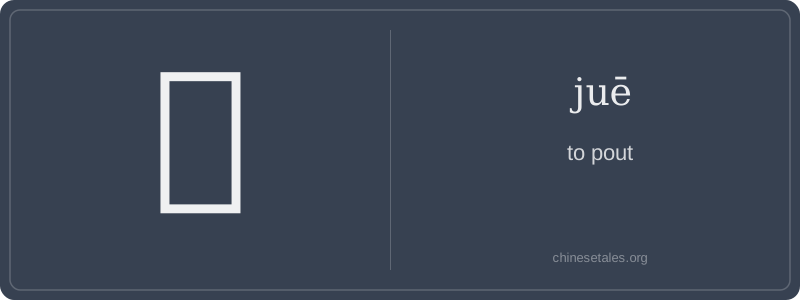
The earliest ancestor of 噘 isn’t found in oracle bones, but its structure reveals its logic: 口 (kǒu, mouth) on the left — anchoring it to speech and facial expression — and 屈 (qū, to bend, yield, or curl) on the right, which itself evolved from a pictograph of a person kneeling with bent back. In bronze script, 屈 emphasized constrained posture; by the Han dynasty, scribes fused it with 口 to create 噘 — literally 'a mouth bent forward', capturing the lip’s involuntary protrusion during petulance or pique.
This fusion wasn’t abstract: classical texts like the 《儿女英雄传》 (1878) use 噘嘴 to describe young women feigning displeasure during courtship — a socially coded, non-verbal signal of modesty or coyness. Over time, the meaning narrowed from general 'bending' or 'curling' (like 屈) to this highly specific lip motion. The character’s fifteen strokes even echo the effort: seven strokes for 口, eight for 屈 — a near-perfect balance between the passive mouth and the active, stubborn bend.
Imagine a four-year-old in Beijing, cheeks puffed like overinflated balloons, lips thrust forward into a defiant little shelf — not crying, not shouting, but radiating pure, silent protest. That’s 噘 (juē): not just 'pouting' as a vague emotion, but the *physical act* of jutting the lower lip outward, often with eyebrows knitted and arms crossed. It’s visceral, performative, and deeply expressive — a tiny theatrical gesture loaded with childish indignation or playful coquetry.
Grammatically, 噘 is almost always used as a verb in the reduplicated form 噘嘴 (juē zuǐ) — 'to pout one’s lips' — or as the standalone verb 噘 (juē) in colloquial speech, especially in northern dialects and dialogue: '她一听说不买玩具就噘起嘴了' (Tā yī tīng shuō bù mǎi wánjù jiù juē qǐ zuǐ le). Note: it’s rarely used alone without context or a complement like 起 or 成; learners who say '*她噘了' sound unnatural, like saying 'She pouted!' in English without any tone or follow-up — it needs that physicality or consequence baked in.
Culturally, 噘 carries a gentle, almost affectionate connotation — think of grandparents teasing a sulking grandchild: '哟,噘嘴啦?小心嘴挂住个油瓶!' (Oh, pouting already? Careful — your lip’ll catch an oil bottle!). It’s rarely used for adults in formal writing (too informal, too childish), and never for anger — that’s 生气 (shēngqì) or 发火 (fāhuǒ). Confusing it with 撅 (juē, to lift/raise something stiffly, e.g., 撅屁股) is common, but that character has 扌 (hand radical), not 口 — a crucial visual and semantic divide.