噗
Character Story & Explanation
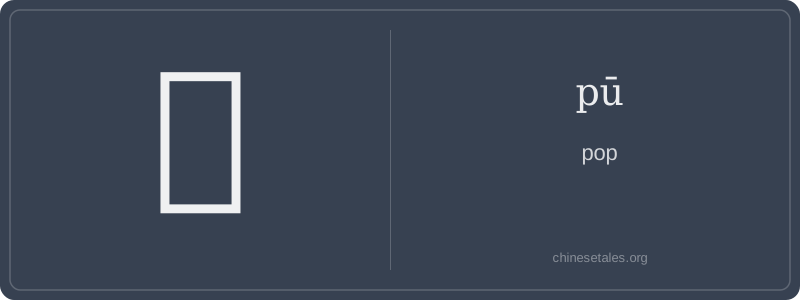
The earliest form of 噗 appears not in oracle bones but in later seal script, where it combines 口 (kǒu, ‘mouth’) — the radical — with 普 (pǔ, ‘universal’), used here purely for sound (phonetic loan). Visually, it’s a mouth spitting out something universal — or perhaps, humorously, ‘the universal sound of human air escaping’. The modern character preserves this structure: the left 口 frame (3 strokes) encloses the right-side 普 (12 strokes), whose top 艹 (grass radical) evolved from ancient ‘sun’ or ‘cover’ glyphs, and whose bottom 丿一曰 (piě yī yuē) simplified from ‘speech’ or ‘utterance’ components — reinforcing its vocal, expressive nature.
By the Tang dynasty, 噗 appears in poetry and vernacular texts as a colloquial interjection — Li Bai never used it (too refined), but Song dynasty storytellers did, capturing streetwise speech in ‘huaben’ tales. Its meaning stayed remarkably stable: always breath-driven, always oral, always mildly subversive. Interestingly, its visual weight — 15 strokes — mirrors its phonetic heft: a heavy, open-mouthed exhalation. No classical dictionary defines it as ‘polite’; it’s the character that arrives when decorum leaves the room — and that hasn’t changed in a thousand years.
Think of 噗 (pū) as Chinese onomatopoeia’s punk rock cousin — it’s not just ‘pop’ like a bubble bursting, but the full-body, slightly undignified *explosive release*: a startled gasp, a cartoonish spit-take, a sudden puff of steam from a teapot, or even the sound of someone blowing air out their mouth in exasperation. Unlike English ‘pop’, which often implies sharpness and closure (a balloon popping), 噗 carries breathiness, openness, and mild comic irreverence — it’s always oral, always involuntary, and almost always accompanied by physical gesture.
Grammatically, 噗 is nearly always an interjection or verb complement — you’ll hear it standalone (‘噗!’), reduplicated for effect (‘噗噗’), or tacked onto verbs like 噗地一笑 (pū de yī xiào — ‘laughed with a sudden *puff*’) or 噗嗤 (pū chī — ‘snort-laugh’). It rarely stands alone as a main verb; learners mistakenly try to say ‘I pū’ — but no: you *xiao* (laugh) *pū*, you *tǔ* (spit) *pū*. Its power lies in embellishment, not action.
Culturally, 噗 is the sound of emotional leakage — embarrassment, suppressed laughter, or impolite relief — making it frequent in internet slang (e.g., ‘噗,你认真的?’ — ‘Pffft, are you serious?’) and light fiction. A common mistake? Using it where silence or dignity is expected — imagine saying 噗 during a formal toast! Also, don’t confuse its breathy *pū* with the sharper *pā* (啪) or guttural *hā* (哈); tone and voicing matter: it’s unaspirated, low-falling, and mouth-wide-open — like blowing out a candle while rolling your eyes.