噔
Character Story & Explanation
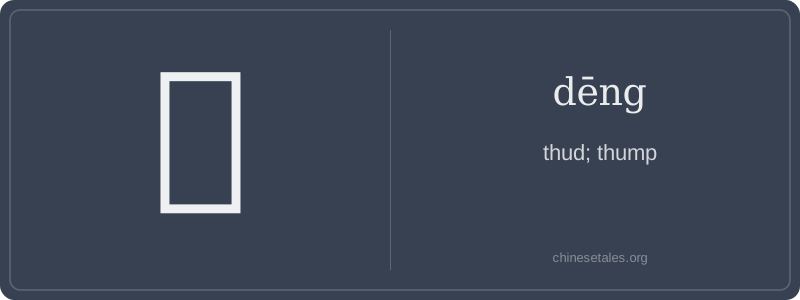
The earliest form of 噔 doesn’t appear in oracle bone or bronze inscriptions — it’s a latecomer, born in the Ming–Qing vernacular literature era as a phonetic-semantic compound. Its left side 口 (kǒu, 'mouth') was added to signal its function as a spoken sound, while its right side 登 (dēng) was borrowed solely for pronunciation. Visually, 登 itself evolved from a pictograph of feet climbing steps — but here, those 'steps' (the top two horizontal strokes + the 'shepherd’s crook' shape) became abstracted into a dense, downward-heavy cluster, mirroring the physical sensation of impact. The final stroke — the long, emphatic捺 (nà, 'press-down') — lands like a foot stomping, sealing the 'thud' visually.
登 entered literary Chinese as a verb meaning 'to ascend,' but scribes repurposed its strong, resonant syllable to evoke sudden, heavy sounds — especially those with downward motion or abrupt cessation. By the time of Qing dynasty novels like Strange Tales from a Chinese Studio, 噔 appeared in dialogue tags like '噔的一聲,門開了' ('Dēng — the door flew open'), anchoring suspense and physicality. Its visual density (15 strokes!) mirrors its acoustic weight — unlike light, quick sounds like 啪 (pā) or 叭 (bā), 噔 feels thick, grounded, and slightly theatrical.
Think of 噔 (dēng) as the cartoonist’s sound effect brought to life in Chinese — it’s not just 'a thud,' it’s the visceral, slightly comical *thump* of a dropped watermelon, a clumsy sit-down, or a cartoon anvil hitting the ground. It’s onomatopoeic through and through: the mouth radical 口 tells you this is speech- or sound-related, and the right side 登 (dēng, 'to ascend') isn’t about climbing — it’s purely phonetic, giving the 'dēng' sound while adding rhythmic weight. Unlike verbs like 掉 (diào, 'to drop'), 噔 stands alone as an interjection or adverbial modifier — you’ll hear it in spoken Mandarin as a standalone burst ('Dēng!') or attached to verbs like 噔地一聲 (dēng de yī shēng) meaning 'with a thud.'
Grammatically, it almost never appears without support: it loves particles like 地 (de) for adverbial use (e.g., 噔地坐下去) or 聲 (shēng, 'sound') for noun phrases. Learners often mistakenly try to use it as a verb ('He dēnged the door') — but no, it doesn’t conjugate! It’s a sonic snapshot, not an action. You’ll rarely see it in formal writing; it lives in dialogue, subtitles, comics, and expressive storytelling.
Culturally, 噔 carries playful exaggeration — it’s the sound of slapstick, not solemnity. Western learners sometimes overuse it trying to sound ‘fluent,’ but native speakers deploy it sparingly for comedic timing or vivid imagery. Bonus nuance: when doubled (噔噔), it mimics rapid, repeated thuds — like footsteps on stairs or a nervous heartbeat — showing how reduplication transforms mood and rhythm in Chinese sound words.