嘘
Character Story & Explanation
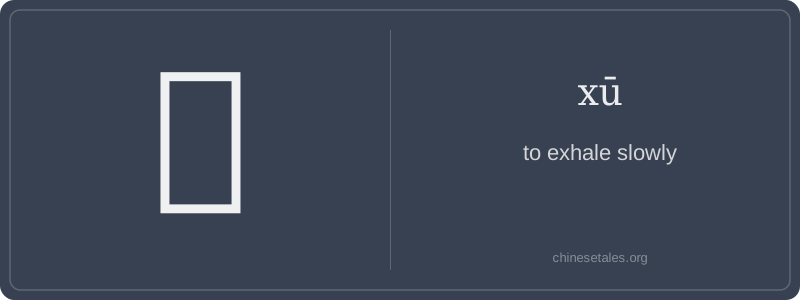
The earliest form of 嘘 appears in seal script as 口 + 虛 — where 虛 itself evolved from oracle bone inscriptions depicting a large, hollow vessel or cave (虍 + 丘 + 丿), symbolizing emptiness and resonance. In 嘘, the 口 radical anchors it to speech and breath, while 虛 visually suggests air flowing into and out of an open space. Stroke by stroke, the modern form preserves this: the left 口 is compact and upright (like lips parting), while the right side retains the layered emptiness — the top 虍 (tiger head) now stylized as two dots and a hook, the middle 丘 (hill) flattened into three horizontal strokes, and the bottom 丿 (a sweeping line) evoking exhaled air drifting away.
This breath-emptiness fusion made 嘘 perfect for expressing controlled exhalation — not gasping or shouting, but deliberate, sound-modulated air. By the Han dynasty, it appeared in texts like the *Shuōwén Jiězì*, defined as ‘to expel breath softly’. Later, in Tang poetry and Ming drama, it acquired performative nuance: a stage whisper, a conspiratorial sigh, or even a lover’s soft breath near an ear. The character’s shape still mirrors its function — the 口 opens just enough; the 虛 flows outward — like watching breath fog a cold window.
At its heart, 嘘 isn’t just ‘to exhale slowly’ — it’s the quiet, intentional release of breath that carries weight: a hush to silence a room, a soft puff to cool hot soup, or a theatrical ‘shhh!’ whispered through pursed lips. Visually, it’s built on 口 (mouth), and the right side (虛) hints at emptiness and air — literally ‘empty breath’. This duality makes it both physical and performative: you *do* it with your mouth, but you *mean* it socially.
Grammatically, 嘘 is almost always used as an interjection (‘Shh!’) or verb in imperative or descriptive contexts — never as a standalone noun or subject. Learners often misread it as ‘xū’ meaning ‘need’ (like 需) or confuse its tone; it’s first tone, not fourth. You’ll rarely see it in formal writing, but it’s everywhere in spoken Mandarin: parents shushing toddlers, chefs blowing on broth, even anime dubs using it for ‘psst!’ or ‘hey, over here!’
Culturally, 嘘 carries gentle authority — it’s intimate, not aggressive. Unlike English ‘shut up!’, 嘘 implies shared awareness and quiet cooperation. A common mistake? Using it like a command verb in sentences such as ‘I 嘘 him’ — nope! It’s intransitive unless paired with a preposition (e.g., 嘘了一声, ‘let out a soft “shh”’). Its power lies in its brevity: one mouth-shaped character, one breath, one shared silence.