噏
Character Story & Explanation
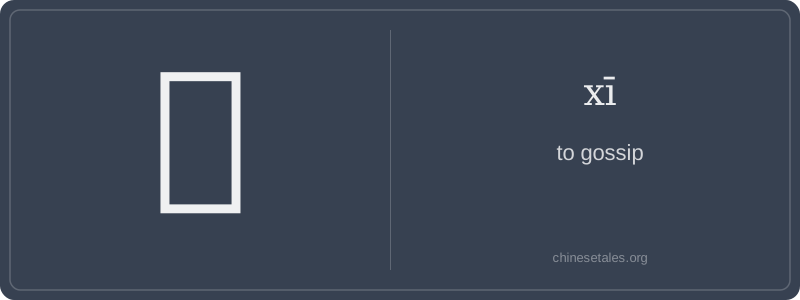
噏 has no oracle bone or bronze script form — it’s a late creation, first appearing in Tang dynasty variant texts and solidifying in Song-era rhyme dictionaries. Visually, it’s a brilliant phonosemantic compound: the left radical 口 (kǒu, ‘mouth’) signals speech-related meaning, while the right component 吸 (xī, ‘to inhale’) provides both sound and semantic reinforcement — gossip isn’t shouted; it’s *drawn in*, breathed out like vapor. The character’s seven strokes evolved cleanly: three for 口 (vertical, horizontal折, closing stroke), four for 吸 (the ‘pulling-in’ hand-like stroke of 厂 + the ‘vital breath’ of 气 stylized as 氵+一+丿).
Its meaning crystallized from 吸’s core idea of ‘drawing inward’: just as one inhales air, one ‘inhales’ secrets — then exhales them selectively, intimately, dangerously. By the Yuan dynasty, 噏 appeared in zaju drama scripts describing servants murmuring palace intrigues ‘噏耳低语’ (xī ěr dī yǔ, ‘whispering into ears’). The visual pun is perfect: mouth + inhalation = speech that enters and exits like breath — fleeting, intimate, and impossible to fully contain.
Think of 噏 (xī) as Chinese ‘whisper-gossip’ — not the loud, dramatic tattling of a soap opera, but the sly, breathy, almost conspiratorial murmur behind cupped hands in a crowded teahouse. It’s not just ‘to gossip’; it’s to *leak* rumor with theatrical quietude — like the hushed ‘psst!’ before revealing a scandal. Unlike generic verbs like 说 (shuō, ‘to speak’) or 议论 (yìlùn, ‘to discuss’), 噏 carries an inherent sense of secrecy, speed, and slight impropriety.
Grammatically, 噏 is almost always used transitively and often appears in literary or regional contexts — rarely in spoken Mandarin today. You’ll see it paired with objects like 秘密 (mìmì, ‘secret’), 隐情 (yǐnqíng, ‘hidden truth’), or 小话 (xiǎohuà, ‘petty talk’). It never stands alone as ‘I gossip’ — instead: 他噏人是非 (Tā xī rén shìfēi, ‘He gossips about others’ faults’). Learners mistakenly treat it like a modern verb and try to add aspect particles (e.g., *噏了*, *噏过*) — but classical usage resists this; it prefers bare form or adverbial modifiers like 暗中 (ànzhōng, ‘in secret’).
Culturally, 噏 evokes pre-20th-century vernacular fiction — think late Ming novels where maids ‘噏’ palace rumors under moonlit corridors. Its rarity today makes it a linguistic fossil: charming, precise, and utterly unsuitable for your HSK mock test. Use it in writing to add archaic texture — but don’t drop it at a Beijing dinner party unless you’re quoting The Plum in the Golden Vase.