噎
Character Story & Explanation
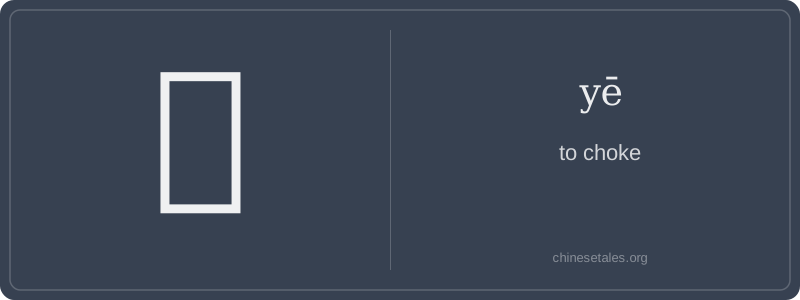
The earliest forms of 噎 appear in Warring States bamboo slips, where it was written with 口 on the left and a simplified version of 殹 (a now-obsolete character meaning 'to block') on the right. That right-hand component evolved from a pictograph showing tangled threads or obstructed water flow — imagine a stream jammed by rocks, visually echoing the suffocating sensation of choking. Over centuries, the right side standardized into the modern 世 + 欠 shape: 世 (shì, 'generation') here isn’t semantic — it’s purely phonetic (both 噎 and 世 were pronounced similarly in Old Chinese), while 欠 (qiàn, 'to yawn/gasp') reinforces the mouth-and-breath theme. The 15 strokes aren’t random: they mimic the tightening, constricting motion of the throat closing.
This character’s meaning stayed remarkably stable — unlike many characters that shifted from concrete to abstract, 噎 has *always* meant 'to choke', both physically and emotionally. In the 4th-century text Shì Shuō Xīn Yǔ (A New Account of Tales of the World), a scholar is described as 噎然不能对 (yē rán bù néng duì) — 'choked silent, unable to reply' — proving its use for speechless emotional shock over 1,600 years ago. The visual design is genius: 口 (mouth) + a 'blocked' right side = no airflow, no words, just raw, breathless pause. It doesn’t describe recovery — only the instant of blockage.
At its core, 噎 (yē) is the visceral, involuntary gasp — the sudden halt of breath when food or emotion blocks your throat. It’s not just physical choking; it’s that lump-in-the-throat moment when you’re too choked up to speak, or when a spicy bite makes you cough mid-sentence. Unlike generic 'to swallow' (吞 tūn) or 'to cough' (咳 ké), 噎 carries tension and interruption: the action starts but *jams*. Think of it as the linguistic equivalent of a hiccup in speech — abrupt, uncomfortable, and impossible to ignore.
Grammatically, 噎 is almost always used intransitively (no object) or with 被 for passive constructions — you don’t ‘choke someone’; you *get* choked (被噎住了). It frequently appears in the reduplicated form 噎得 (yē de) + result complement: e.g., 噎得说不出话 (yē de shuō bu chū huà) — 'choked to the point of speechlessness'. Learners often wrongly add an object ('I choked the chicken') — but 噎 never takes one. Also, it’s rarely used alone as a verb in formal writing; instead, it thrives in spoken, emotive contexts like storytelling or complaints.
Culturally, 噎 has a sly second life: in northern dialects and internet slang, 噎人 (yē rén) means 'to fluster someone with an unexpectedly sharp or awkward remark' — like dropping a sarcastic truth bomb that leaves others speechless. A common mistake? Confusing it with 咽 (yàn/yè), which covers swallowing and sobbing — but 噎 is *only* about obstruction and sudden stoppage. Its radical 口 (mouth) plus the right side’s 'blocked flow' imagery make this distinction crystal clear — once you see it.